Journal of China’s Neighboring Diplomacy, Vol. 9 (2023)
|
|
The Title Page of Journal of China’s Neighboring Diplomacy, Vol. 9 (2023) | The Back Cover of Journal of China’s Neighboring Diplomacy, Vol. 9 (2023) |
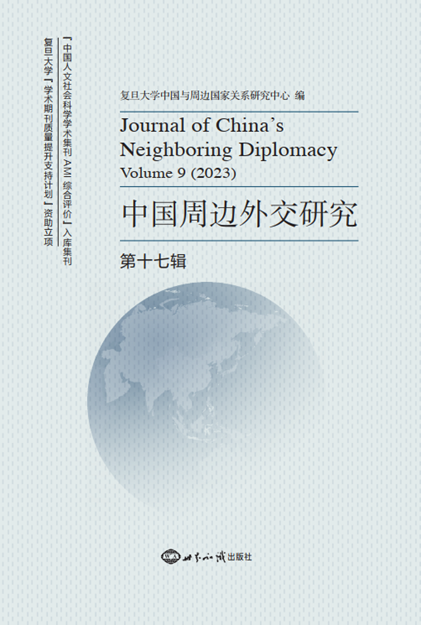
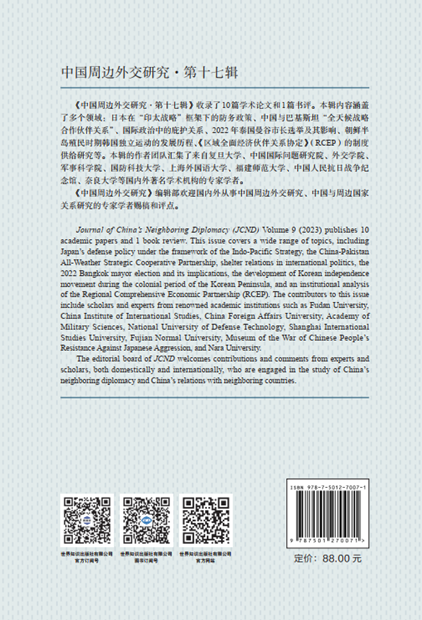
Center for China’s Relations with Neighboring Countries of Fudan University (CCRNC Fudan), ed., Journal of China’s Neighboring Diplomacy, Vol. 9 (2023).
Publisher: World Affairs Press (China)
Published in July 2025.
ISBN: 978-7-5012-7007-1
Contents
Editor’s Introduction................................................................................. XUE Song / 1
Studies on China’s Relations with Neighboring Countries
Analysis of Japanese Defense Policy under the Framework of the “Indo-Pacific Strategy”........................................................ HUANG Jiayu and GUO Yanjun / 5
China-Pakistan All-Weather Strategic Cooperative Partnership: History, Challenges, and Prospects..................................................................................LI Qingyan / 23
The Role of U.S. Foreign Aid Agencies on the Biden Administration’s Pacific Islands Strategy—A Case Study on United States Agency for International Development (USAID) and United States Trade and Development Agency (USTDA)...........................................................................................GE Zekun / 41
Shelter Relations in International Politics: Based on the Investigation of Chinese and Western History ............................................................................. JIANG Bo / 78
Studies on China’s Neighboring Countries
On the Truth of Japan’s “Exploration” and “Development” of Phosphate Resources in the Nansha Islands (Spratly Islands) in the Early 20th Century .................................................................................. LUO Dongyao / 103
Election and Public Opinion: Observations and Analysis of Bangkok Mayor Election in Thailand........................................................................................ YU Qun / 116
The Development of Korean Independence Movement Forces during the Colonial Period of the Korean Peninsula and the Cultivation of Chinese Military Academy............................................................................................LIU Xin / 128
The Choice of Political Propaganda Discourse for the Liberal Democratic Party of Japan: Taking Policy Propaganda Slogans as an Example (2019–2023).................................................................... XIE Letian and XU Jingqi / 153
Studies on Regional Cooperation
Institutional Supply, Hedging Paths, and Strategic Autonomy of ASEAN—Taking the Negotiation of the Regional Comprehensive Economic Partnership (RCEP) as an Example ............................................................GU Jiawei and ZHANG Lan / 181
Promoting Fujian’s High-Quality Development with the Construction of the Core Area of the 21st Century Maritime Silk Road ............................ QIN Qiong / 204
Book Review
Revealing the True History of Indonesian Massacres—A Review of The Killing Season: A History of the Indonesian Massacres, 1965–66 by Geoffrey B. Robinson......................................................................................YIN Kaijun / 219
Appendix
Introduction on Center for China’s Relations with Neighboring Countries of Fudan University (CCRNC-Fudan)........................................................................... / 235
Call for Contributions ............................................................................................ / 237
Author Instructions ................................................................................................. / 239
Analysis of Japanese Defense Policy under the Framework of the “Indo-Pacific Strategy”
Abstract
Amidst efforts by the United States and Western powers to advance their “Indo-Pacific Strategy”, Japan views China as its primary perceived adversary and strategic competitor. Under Prime Minister Fumio Kishida’s administration, Japan has demonstrated exceptional engagement across political, military, and diplomatic domains, while comprehensively upgrading defense policies. On one hand, the Japanese government has released a revised version of its defense policy document to “fundamentally strengthen defense forces”, consolidating traditional combat capabilities while continuously increasing investment in emerging combat domains. On the other hand, Japan has deepened the Japan-U.S. military alliance at the strategic and tactical levels, responding to the operational concepts of the U.S. military, bolstering defense capabilities of the southwest islands, and continuously fortifying military strategic deployments in the southwest. Concurrently with reinforcing the military integration of the Japan-U.S. alliance, Japan is expanding military cooperation with Southeast Asian countries to elevate Japan’s regional leadership and international
influence under the framework of the “Indo-Pacific Strategy”.
Keywords: “Indo-Pacific Strategy”; Japanese defense policy; Japan-U.S. alliance
Authors: Huang Jiayu, Associate Researcher, Strategic Evaluation and Consulting Center, Academy of Military Sciences; Guo Yanjun, Researcher, Institute of Asian Studies (National Security Academy), China Foreign Affairs University.
Official Citation: HUANG Jiayu and GUO Yanjun, Analysis of Japanese Defense Policy under the Framework of the “Indo-Pacific Strategy,” Journal of China’s Neighboring Diplomacy, Vol. 9, 2023, pp. 5-22.
China-Pakistan All-Weather Strategic Cooperative Partnership: History, Challenges, and Prospects
LI Qingyan
Abstract
Since the establishment of diplomatic ties between China and Pakistan, the relationship between the two countries has withstood the test of time and international changes, and has remained rock-solid and unbreakable. In 2015, China-Pakistan relations have been upgraded to an “all-weather strategic cooperative partnership”. In the 21st century, the China-Pakistan Economic Corridor (CPEC) has led to comprehensive and high-level strategic cooperation between the two countries. The scope of China-Pakistan relations has been continuously enriched and expanded, building a closer China-Pakistan community with a shared future in the new era. However, the world today has entered a period of turmoil and turbulence, with increasingly intense competition among major powers, escalating geopolitical conflicts, and increasing security risks. These developments pose significant challenges to China-Pakistan relations and the construction of the CPEC. As all-weather strategic partners, the strategic significance of China-Pakistan relations has become more prominent, necessitating joint efforts to address challenges and achieve common development. Deepening strategic cooperation between China and Pakistan will not only benefit the people of the two countries, but also help maintain regional security and stability, mitigate geopolitical competition, promote the construction of a community with a shared future in neighboring countries, and inject more stability and positive energy into the world.
Keywords: Pakistan; China-Pakistan relations; strategic cooperation; geopolitical competition; security challenges
Author: Li Qingyan, Associate Research Fellow, Department for Developing
Countries Studies, China Institute of International Studies.
Official Citation: LI Qingyan, China-Pakistan All-Weather Strategic Cooperative Partnership: History, Challenges, and Prospects, Journal of China’s Neighboring Diplomacy, Vol. 9, 2023, pp. 23-40.
The Role of U.S. Foreign Aid Agencies on the Biden Administration’s Pacific Islands Strategy—A Case Study on United States Agency for International Development (USAID) and United States Trade and Development Agency (USTDA)
GE Zekun
Abstract
This paper regards USAID and USTDA as research focuses, analyzes all kinds of assistance that U.S. foreign aid agencies have provided to the Pacific Islands Region (PIR) since the inaugural U.S.-Pacific Island Country Summit, and finds out five representative features that these foreign aid agencies have shown. This paper also carries out a full-scale examination about the strategic purposes by which U.S. foreign aid agencies are driven to promote targeted assistance to the Pacific Island Countries (PICs), and summarizes these agencies’ performances on “opening up PICs’ local/regional markets and enlarging domestic job-oriented export opportunities”, “assisting the Biden administration to minimize China’s position and influence in the PIR”, “cultivating regional economic system under the American economic model and tightening the U.S.’s influence and control on key firms within this region through financial aids”, and “meeting Democratic voters’ value preference by providing suitable climate finance to the PICs, thus bolstering the Democratic Party’s prospects in the 2024 U.S. presidential election”. In addition, this paper explores the initial key areas and specific contents of aids provided by U.S. foreign aid agencies to the PICs, accordingly proposes three targeted policy recommendations, and ends with a scientific perspective of future researches based on the shortcomings of existing discussions.
Keywords: U.S. foreign aid agencies; the U.S.’s Pacific Islands Strategy; USAID; USTDA
Author: Ge Zekun, PhD candidate (2022 intake), School of International Relations & Public Affairs, Fudan University.
Official Citation: Ge Zekun, The Role of U.S. Foreign Aid Agencies on the Biden Administration’s Pacific Islands Strategy—A Case Study on United States Agency for International Development (USAID) and United States Trade and Development Agency (USTDA), Journal of China’s Neighboring Diplomacy, Vol. 9, 2023, pp. 41-77.
Shelter Relations in International Politics: Based on the Investigation of Chinese and Western History
JIANG Bo
Abstract
In international relations theory, whether the study on hegemonic systems or tribute systems, these studies usually focus on exploring hierarchical system from the perspectives of power coercion and cultural conscription, neglecting the research aspect of major powers using shelter relations to establish hierarchical systems. This article aims to re-examine the concept of shelter based on this, clarify the dual path of “power and legitimacy” inherent in shelter relationships, propose two ideal types of shelter relationships: “coercive” and “authority”, and compare the differences between Chinese and Western shelter relationships based on different historical contexts. This article found that although power and legitimacy are two major internal factors in shelter relationships, the legitimacy factor is more prominent in ancient Chinese shelter relationships than in Western countries’ shelter relationships, and there is more emphasis on building authority and less focus on coercion.
Keywords: power; shelter; legitimacy; hierarchy; shelter relationship
Author: Jiang Bo, PhD candidate (2022 intake), School of International Relations & Public Affairs, Fudan University.
Official Citation: JIANG Bo, Shelter Relations in International Politics: Based on the Investigation of Chinese and Western History, Journal of China’s Neighboring Diplomacy, Vol. 9, 2023, pp. 78-100.
On the Truth of Japan’s “Exploration” and “Development” of Phosphate Resources in the Nansha Islands (Spratly Islands) in the Early 20th Century
LUO Dongyao
Abstract
According to Japanese documents, in the early 20th century, the Rasa Island Phosphate Ore Co., Ltd. went “exploring” the Nansha Sea area and “developed” the phosphate resources there. In fact, the phosphate reserves in the Nansha Islands are scarce, and the quality is poor. Besides that, the company’s business has been deteriorating since 1919, after which the company has had a lot of debts and has no funds for “exploration” or “development”. The “true exploration developer” of the Nansha phosphate mine is not the company, but the Japanese Navy. The relationship between the two is not that the company’s “exploration” requires the cooperation of the Japanese Navy, but that the Japanese Navy’s “exploration” and “development” need to borrow the name of the company. In order to conceal its identity, the Japanese Navy dispatched reservists and paramilitary personnel from military-affiliated companies to the Nansha Sea area under the pretext of “expeditions”, and also built temporary wooden structures on Taiping Island and Nanzi Island, and smuggled some phosphate samples home. The purpose of the Japanese Navy’s “exploration” and “development” was not to acquire phosphate resources, but to create evidence for the future acquisition of territorial rights over the Nansha Islands.
Keywords: Nansha Islands; Nansha Islands phosphate resources; South China Sea issue; Rasa Island Phosphate Ore Co., Ltd.
Author: Luo Dongyao, Professor, Nara University.
Official Citation: LUO Dongyao, On the Truth of Japan’s “Exploration” and “Development” of Phosphate Resources in the Nansha Islands (Spratly Islands) in the Early 20th Century, Journal of China’s Neighboring Diplomacy, Vol. 9, 2023, pp. 103-115.
Election and Public Opinion: Observations and Analysis of Bangkok Mayor Election in Thailand
YU Qun
Abstract
In the Bangkok mayoral election held on May 22, 2022, Chadchart Sittipunt was elected by a large margin due to his positive personal image, accurate political positioning for the election, and an appealing campaign platform. For various reasons, the pro-government faction lagged far behind the opposition. This election exhibited four major characteristics. First, it transcended the historical two-party competition, evolving into a confrontation between pro-government and anti-government camps. Second, both Chadchart and Asawin ran as independent candidates, but were seen as “proxies” for
the two major parties in the House of Representatives. Third, there was intense internal competition within both camps. Fourth, traditional electoral psychological tactics were largely ineffective. The Bangkok mayoral election reflected the lackluster performance of Prime Minister Prayuth Chan-o-cha and the Palang Pracharath Party over the past three years, with continuously declining public support and intensified internal government conflicts. The election results are expected to significantly influence the upcoming national elections.
Keywords: Thailand; the Bangkok mayoral election; Prayuth Chan-o-cha government; the Palang Pracharath Party; Pheu Thai Party
Author: Yu Qun, Director of the Southeast Asian Studies Center, Associate Professor, School of International Studies, National University of Defense Technology.
Official Citation: YU Qun, Election and Public Opinion: Observations and Analysis of Bangkok Mayor Election in Thailand, Journal of China’s Neighboring Diplomacy, Vol. 9, 2023, pp. 116-127.
The Development of Korean Independence Movement Forces during the Colonial Period of the Korean Peninsula and the Cultivation of Chinese Military Academy
LIU Xin
Abstract
The Fourth Industrial Revolution has been sweeping the globe for the past ten years, and competition among major powers has been increasingly fierce since then. In terms of the semiconductor industry, the U.S. firmly holds the world technological hegemony at this stage, but South Korea also ranks among the top tier because of its large market share in the world semiconductor market. Just after the U.S. against this drop back, South Korea promoted a national-level semiconductor strategy and strengthened its technological cooperation with the U.S. to maintain and enhance its position in global semiconductor industry. From the perspective of technology nationalism, South Korea’s current semiconductor strategy is both defensive and offensive, but in the near future, it’s highly likely that the offensive side will prevail. The influencing factors include South Korea’s political conservatism, nationalism, and more importantly, the U.S. factor. By then, it will weigh more pressure on China’s semiconductor industry.
Keywords: military schools; mutual assistance between China and Korea; independent movement; the War of Resistance Against Japanese Aggression
Author: Liu Xin, Associate Researcher, Data Editing Department, Museum of the War of Chinese People’s Resistance Against Japanese Aggression.
Official Citation: LIU Xin, The Development of Korean Independence Movement Forces during the Colonial Period of the Korean Peninsula and the Cultivation of Chinese Military Academy, Journal of China’s Neighboring Diplomacy, Vol. 9, 2023, pp. 128-152.
The Choice of Political Propaganda Discourse for the Liberal Democratic Party of Japan: Taking Policy Propaganda Slogans as an Example (2019–2023)
XIE Letian, XU Jingqi
Abstract
This study takes the policy propaganda slogans of the Liberal Democratic Party of Japan (LDP) from 2019 to 2023 as the research object. According to the discourse use of propaganda slogans, this study explores the changes of propaganda slogans in a specific period and the reasons for them. It is found that the formulation of LDP policy propaganda slogans is closely related to the changes in Japan and abroad during a specific period. It is also influenced by the will of the LDP president and reflects the unique political demands of the LDP during that period. At the same time, slogans often use words related to themes such as “Japan”, “future” and “era”. At the level of discourse selection, the LDP’s policy propaganda slogans have the characteristics of grand, concise, and future-oriented, and try to attract public attention, enhance political exposure, and increase the party’s support rate. In terms of practical effectiveness, the propaganda slogans formulated by the LDP played the role of auxiliary political mobilization to a certain extent. Still, in the process of coping with crises, the propaganda slogans were often too empty and had the opposite effect of weakening public support.
Keywords: Liberal Democratic Party; propaganda slogans; political propaganda; Japanese elections
Authors: Xie Letian, PhD candidate in National Security Studies, School of International Relations & Public Affairs, Fudan University; Xu Jingqi, Associate Professor, School of Journalism and Communication, Sichuan International Studies University.
Official Citation XIE Letian and XU Jingqi, The Choice of Political Propaganda Discourse for the Liberal Democratic Party of Japan: Taking Policy Propaganda Slogans as an Example (2019–2023),Journal of China’s Neighboring Diplomacy, Vol. 9, 2023, pp. 153-178.
Institutional Supply, Hedging Paths, and Strategic Autonomy of ASEAN—Taking the Negotiation of the Regional Comprehensive Economic Partnership (RCEP) as an Example
GU Jiawei, ZHANG Lan
Abstract
The hedging strategy is an important strategy for Global South countries to seek autonomy in the cracks of big powers. Southeast Asian countries have always been fertile ground for scholars to carry out research on hedging strategies. However, the research on hedging strategies of regional integration organizations (such as ASEAN) is very limited. RCEP is the cooperation framework established by ASEAN to hedge internal and external risks under the background of profound changes in the cooperation pattern of the Asia-Pacific region. It is also an important case to observe ASEAN’s maintenance of autonomy through hedging strategies. Under the background of increasing system pressure, ASEAN’s institutional supply provides normative guarantee for RCEP framework to play a hedging role, and the transformational hedging path determines the direction of hedging effectiveness. The institutional philosophy with the “ASEAN approach” as the core, flexible agenda setting rules, and multi-level institutional networks are the guarantee for the RCEP framework to play a hedging role. The transformational hedging approach adopted by ASEAN attracts a wide range of stakeholders and maintains strategic autonomy under the framework of multilateralism. The hedging effects of RCEP remain to be seen. The future of ASEAN maintaining autonomy through hedging strategies is still hindered and difficult.
Keywords: hedging strategy; ASEAN; strategic autonomy; Regional Comprehensive Economic Partnership
Authors: Gu Jiawei, Lecturer, School of International Relations and Public Affairs, Shanghai International Studies University; Zhang Lan, Post doctor, School of International Relations & Public Affairs, Fudan University.
Official Citation: GU Jiawei and ZHANG Lan, Institutional Supply, Hedging Paths, and Strategic Autonomy of ASEAN—Taking the Negotiation of the Regional Comprehensive Economic Partnership (RCEP) as an Example, Journal of China’s Neighboring Diplomacy, Vol. 9, 2023, pp. 181-203.
Promoting Fujian’s High-Quality Development with the Construction of the Core Area of the 21st Century Maritime Silk Road
QIN Qiong
Abstract
In the face of the great changes unseen in a century, adhering to a high level of opening up and jointly building the Belt and Road is an important path to high-quality development. As the core area of the 21st Century Maritime Silk Road, Fujian practices the spirit of the Silk Road, adheres to the development and inheritance of the real economy, relies on overseas Chinese resources, takes Mazu culture, Minnan culture, and Hakka culture as the identification link, adheres to the united front, demonstrates the achievements of the Chinese path to modernization to the world in various forms, works with the progressive forces to build a community with a shared future for mankind.
Keywords: Belt and Road Initiative; high-quality development; Fujian
Author: Qin Qiong, Associate Professor, School of Literature, Fujian Normal University.
Official Citation: Qin Qiong, Promoting Fujian’s High-Quality Development with the Construction of the Core Area of the 21st Century Maritime Silk Road, Journal of China’s Neighboring Diplomacy, Vol. 9, 2023, pp. 204-216.
Revealing the True History of Indonesian Massacres—A Review of The Killing Season: A History of the Indonesian Massacres, 1965–66 by Geoffrey B. Robinson
YIN Kaijun
Abstract
This article is a review of Geoffrey B. Robinson’s book The Killing Season: A History of the Indonesian Massacres, 1965–66. This article argues that the book convincingly demonstrates that the 1965–1966 massacres in Indonesia are not ethnically specific fanatic massacres, but rather organized massacres driven by a militaristic system, dominated by the military, and supported by the United States and other Western countries behind the scenes. The book not only demonstrates the specific mechanism and the special motivation of the massacres, but also explains in detail the social environment in which the massacres took place, which enriches our understanding of the anti-human crimes. The criticism of the book focuses on the analysis and writing level, stating that it does not pay attention to the resistance struggle of the massacred at that time, while overemphasizing the role of non-governmental organizations. Although the massacres have passed into history, the book remains highly relevant and contributes to a deeper understanding of Indonesia’s political structure and collective social memory.
Keywords: Indonesia; massacres; military
Author: Yin Kaijun, PhD candidate, Institute of Area Studies, PekingUniversity.
Official Citation: Yin Kaijun, Revealing the True History of Indonesian Massacres—A Review of The Killing Season: A History of the Indonesian Massacres, 1965–66 by Geoffrey B. Robinson, Journal of China’s Neighboring Diplomacy, Vol. 9, 2023, pp. 219-231.