(Source:Global Times,2026-10-28)
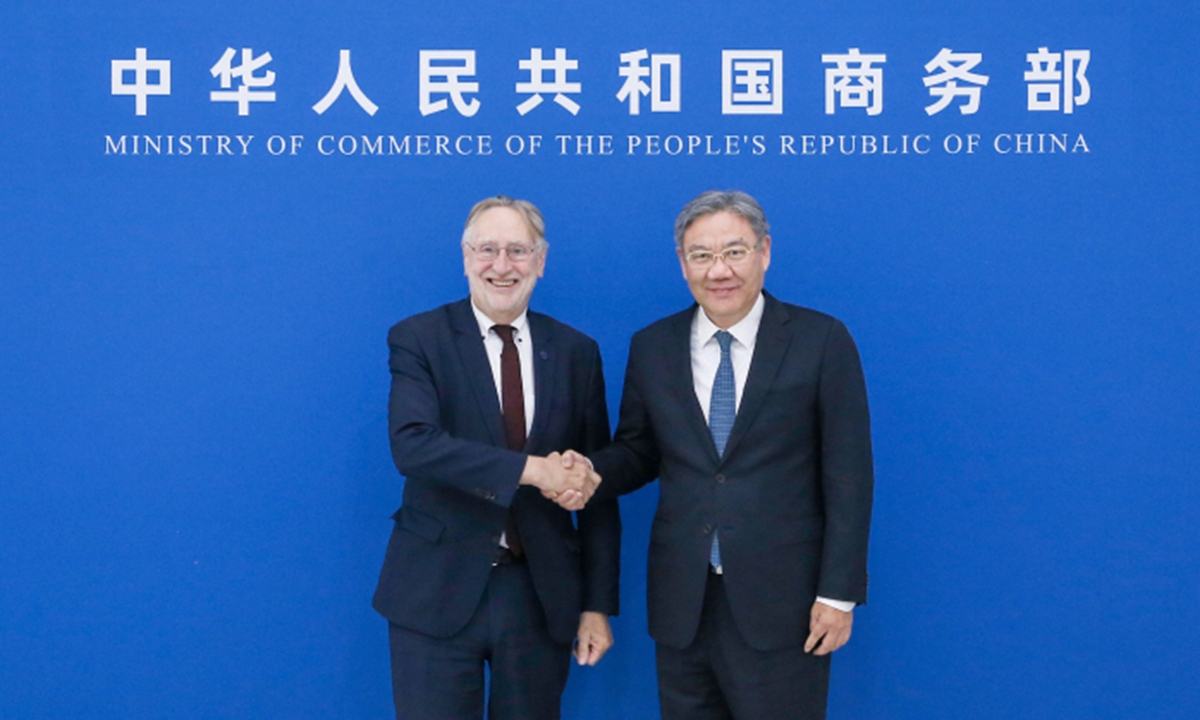
Chinese Commerce Minister Wang Wentao said on Tuesday that China and the EU are key forces in upholding the multilateral trading system, stressing that China is not the source of the EU's problems but a partner in solving them. He urged the EU to work with China to promote more balanced and mutually beneficial trade in line with World Trade Organization (WTO) rules.
Wang made the remarks during a meeting with Bernd Lange, chair of the European Parliament's Committee on International Trade, according to the ministry's official statement on Wednesday.
The meeting came amid renewed efforts by China and the EU to stabilize bilateral trade ties, following productive talks earlier this month that yielded 16 points of consensus on issues including trade and investment, export controls and WTO reform.
China and the EU have held two meetings under their trade and investment consultation mechanism this year, reaching substantial outcomes and consensus. Wang stressed that this fully demonstrates their willingness, ability and wisdom to resolve each other's trade and economic concerns through dialogue.
Wang noted that the EU has recently stepped up restrictive trade efforts, negatively affecting the stability of China-EU industrial and supply chains and cooperation between businesses on both sides.
Wang stressed that China is not the source of the EU's problems, but a partner in addressing them. He expressed hope that the EU would work with China to promote more balanced and stronger bilateral trade by expanding two-way investment, increasing imports from the EU and broadening cooperation in emerging sectors, in line with WTO rules and the principles of reciprocity and mutual benefit.
China's Ministry of Commerce is willing to strengthen communication with the committee to jointly promote the stable and sound development of China-EU economic and trade relations, Wang said.
Lange said that the EU is willing to develop stable and balanced economic and trade relations with China, uphold the multilateral trading system, advance WTO reform and promote global economic growth. He added that the EU welcomes investment from Chinese companies and is willing to explore new areas of cooperation for mutual benefit.
The latest exchanges reflect China's commitment to maintaining dialogue with the EU at multiple levels despite lingering trade frictions, Jian Junbo, director of the Center for China-Europe Relations at Fudan University's Institute of International Studies, told the Global Times on Wednesday. He noted that the European Parliament plays an important role in shaping EU trade policies, making engagement with its trade committee particularly significant.
Jian said that the meetings demonstrate China's willingness to work with different EU institutions to manage trade disputes and deepen cooperation, rather than relying on unilateral restrictions to address economic differences. Such exchanges are particularly important at a time when bilateral trade relations face challenges, as sustained dialogue can help build mutual trust and maintain stability in China-EU economic ties, he added.
The latest round of engagement follows a breakthrough in China-EU trade consultations on October 8 and 9, when the two sides reached 16 points of consensus covering trade and investment, export controls, intellectual property rights and WTO reform.
Among the outcomes, the two sides reached an understanding on hybrid vehicle trade in a manner consistent with WTO rules, agreed to explore possible tariff reductions on certain goods and pledged to continue addressing market access concerns. They also agreed to hold another ministerial meeting in March 2027, with a video conference scheduled for January.
The European Round Table for Industry, a group representing leading European industrial companies, welcomed the October trade consultation outcomes, saying in an October 14 statement that progress on hybrid vehicles, rare-earth export licensing and market access was "positive and helpful for European and Chinese businesses."
Yet trade tensions persist despite the recent progress. European Commission (EC) President Ursula von der Leyen said on October 16 that the EU would propose further restrictions on Chinese imports, arguing that the deal on hybrid vehicles would not fix the trade imbalances, Reuters reported.
Such an approach exposes the persistent tendency among some European policymakers to use pressure as a bargaining tool in trade negotiations, rather than seeking mutually beneficial solutions through dialogue, Chinese experts noted.
Europe needs to move away from the mindset of using economic pressure as leverage in trade negotiations, Hu Qimu, a Chinese economist, told the Global Times, stressing that protectionist measures cannot address its underlying economic challenges.