(Source:China Daily,2025-10-29)
Takeover to avoid theft of outdated chip technology ridiculous and risks breaking laws and bilateral relations, Zhang Zhouxiang reports in Brussels.
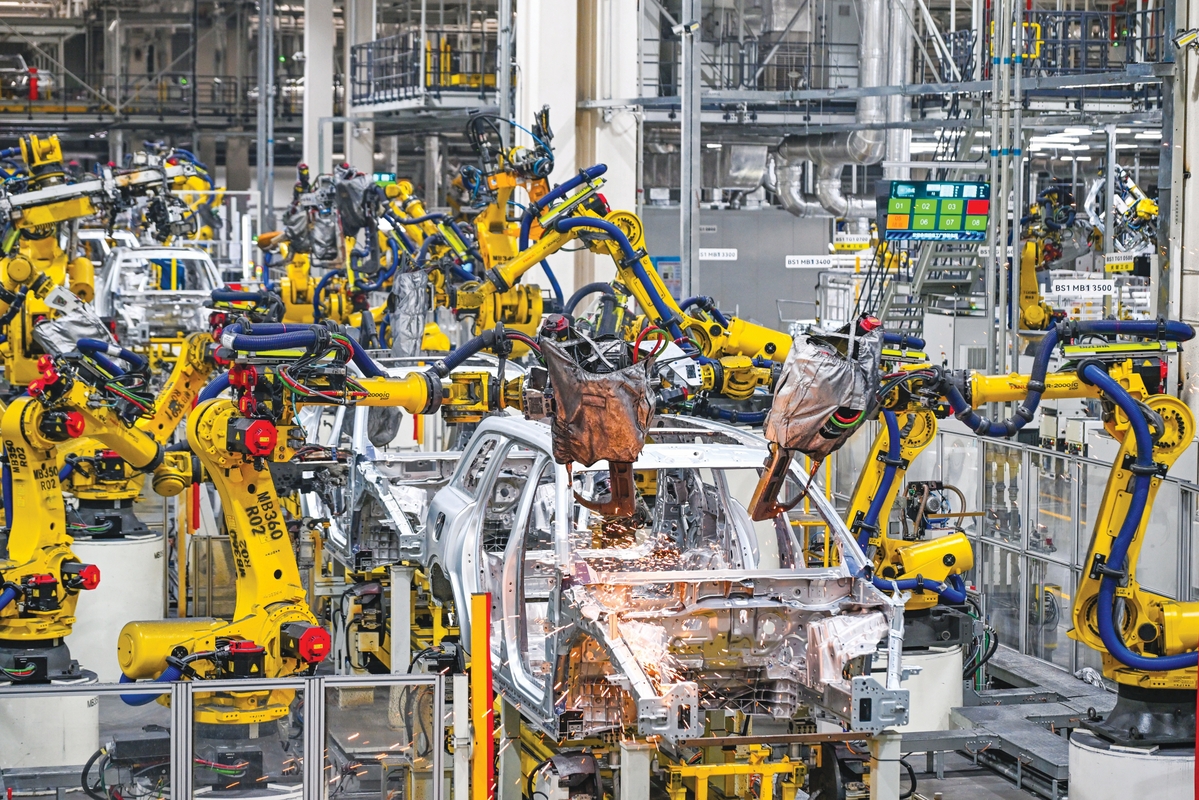
The number of chips needed for each car has risen from 600 for combustion-powered vehicles to 1,600 for electric vehicles as cars have been getting more intelligent. WANG QUANCHAO / XINHUA
One month into the chip-shortage crisis ignited by the Netherlands government's takeover of Chinese-owned and Netherlands-based semiconductor manufacturer Nexperia, skepticism about the decision has been emerging from all sides, with concerns expressed that the rules of international trade have been violated and that the interests of all stakeholders, the Netherlands included, stand to suffer.
The Netherlands government announced on Sept 30 it would take control of Nexperia for one year, forbidding the company and its subsidiaries from making adjustments to assets, intellectual property, its business, or workforce.
The Netherlands' stated reason was that Nexperia, its Chinese parent company Wingtech Technology, and its Chinese national CEO Zhang Xuezheng, had serious governance shortcomings and that these posed a threat to the continuity and safeguarding on Dutch and European soil of crucial technological knowledge and capabilities, and economic security.
According to media reports, the decision was made after the CEO of Nexperia allegedly tried to rearrange its European operations.
The intervention risks producing just the result the government says it wants to prevent, Herman Quarles van Ufford, senior policy-fellow at the European Council on Foreign Relations, wrote on its official website. It poses an existential crisis to Nexperia as a company; and supply shortages resulting from Chinese countermeasures appear set to seriously disrupt car production.
According to Nexperia's own website, the company produces chips for automotive use, including bipolar transistors, diodes, MOSFETs, and variants.
Its Sustainability Report 2024 states that sales to the Americas (primarily the United States) reached $192 million, up from $119 million in 2020, while sales to Europe, the Middle East, and Africa, with Europe dominating, rose from $289 million to $457 million in the same period.
Many car manufacturers in Europe and the US rely on Nexperia for supplies.
If the Nexperia saga ends in the shutdown of the US auto industry, it would be the irony to end all ironies, as it would effectively mean the US sanctioned their own industrial base (given it all originated with US sanctions pressuring the Netherlands to seize Nexperia away from China), entrepreneur Arnaud Bertrand, of MeAndQi.com, wrote on X. Lesson number one when you throw a grenade: make sure you don't stand right in the blast radius.
By this, he referenced a new regulation released by the US Department of Commerce on Sept 29 that expanded export-control sanctions to subsidiaries that are more than 50 percent owned by US-listed entities as of Oct 1, to which Wingtech is an old member and Nexperia would be a new one. Many believe this change pushed the Netherlands government into a hasty decision.
The exposure is not limited to the US. Europe is also in the firing line. According to the Daily Telegraph newspaper, carmakers became hooked on Chinese chips and now can't get them. In car-manufacturing powerhouse Germany, a Deutsche Welle report found that companies are so short of chips that Volkswagen says it expects work stoppages if an alternative isn't found.
If Germany wants to save its car industry, the foreign minister should go to the Netherlands and ask for reversing the seizure of Nexperia, wrote Glenn Diesen, a professor of political science at the University of South-Eastern Norway.
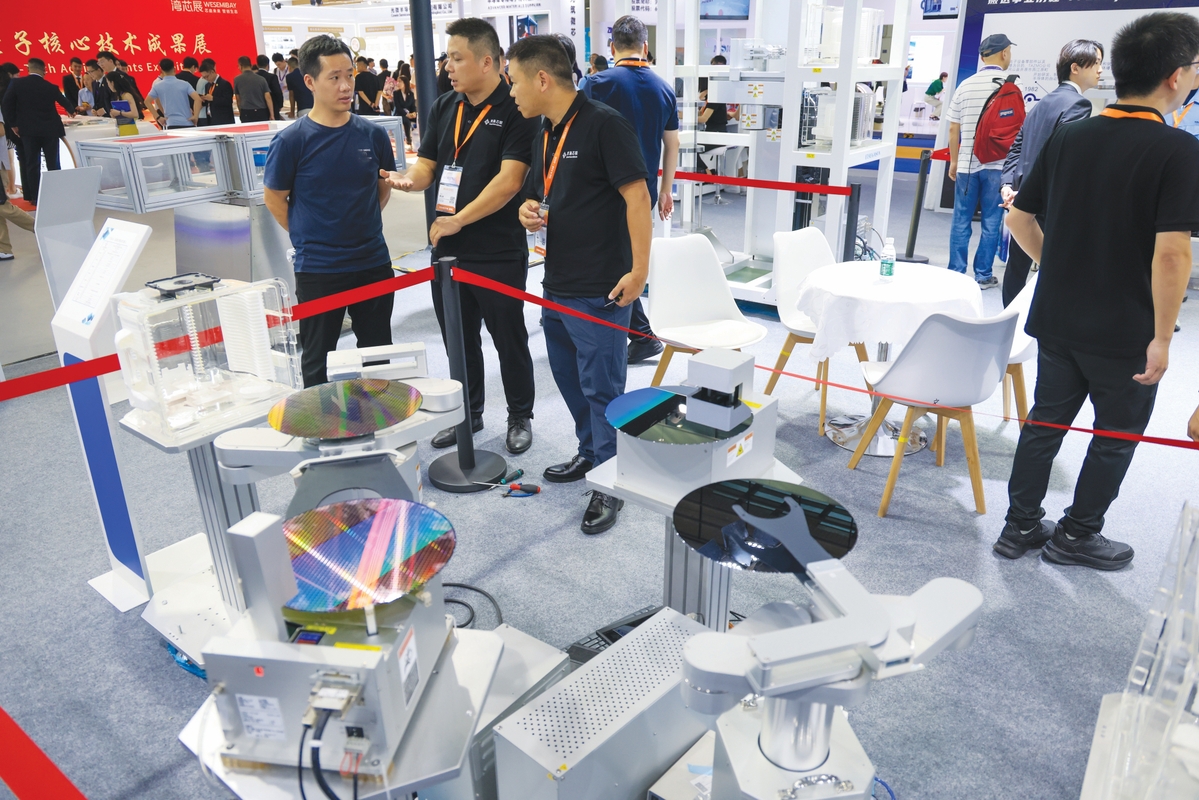
A robot moves silicon wafers for processing at the Wesemibay Semiconductor Ecosystem Expo 2025 in Shenzhen, Guangdong province, which attracted more than 600 companies that exhibited technologies including wafer-making and chip design. MAO SIQIAN / XINHUA
Old tech not worth stealing
One of the concerns of the Netherlands government is that Nexperia's technologies are being transferred to, or stolen by, Chinese companies via Wingtech, which, according to experts, is a ridiculous suggestion.
Nexperia's technologies, at least in the chips sector, are not advanced, said Chen Jing, a chip industry analyst at thinktank Fengyun Institute, who explained that Nexperia mainly produces foundational chips for automotive electronic systems, namely lighting, airbags, door locks, and windows that are far from cutting-edge, as evidenced by some of their products being made at the 350 nm process nodes.
The chips used for cars might follow a different standard from others, but 350 nm is not a very difficult problem for Chinese mainland chipmakers. So, why trouble stealing them? Chen said.
In Chen's view, Nexperia's market share, as high as 40 percent in Europe in certain sectors, owes less to proprietary advanced technology than to economies of scale, after the enterprise was acquired by a Chinese company that was able to lower its costs.
Echoing this, industry site Eepower reported that with further reach into the Chinese market and expanded capacity to meet new demand, Nexperia surpassed $1 billion in sales in 2018.
In a statement on Oct 13, Wingtech reported that Nexperia's gross margin rose from 25 percent in 2020 to 42.4 percent in 2022, and that by October 2024 it had cleared all pre-existing debt, achieving zero debt.
German media outlet Handelsblatt quoted Volkswagen's brand-production executive Christian Vollmer as saying: We have an alternative supplier who could compensate for the delivery shortfall of Nexperia semiconductors.
But that only underscores the risk — such alternatives may exist, but switching is costly and time-consuming for automotive supply chains.

An employee works on a production line at Netherlands semiconductor company Nexperia, in Hamburg, Germany, on June 27, 2024. Fabian Bimmer / REUTERS
Seizure breaks law & relations
While clearly shooting itself in the foot with its decision, the Netherlands government also risks violating international law and turning the whole exercise into a farce, experts say.
Sun Nanxiang, an associate researcher at the Institute of International Law, Chinese Academy of Social Sciences, raises the fundamental question of legitimacy.
Under any pretext, so roughly taking over a foreign company is illegal, Sun said. This is expropriation of private property, especially of a third-country entity, and clearly breaches basic international-law norms.
He points out a government might normally only seize a private company in such a way during wartime, and that doing so while economic relations are active is unprecedented.
Social-media influencer Lord Bebo asked: What level of democracy and capitalism is that? A state taking control of a company because it is deemed at risk of mismanagement?
Jian Junbo, director of the Center for China-Europe Relations at Fudan University, described the case as historic and without precedent and warned: In Europe, both state and enterprise normally respect international rules and operate under strict regulation, but now a legitimate multinational enterprise can be taken over by a national government. That damages Europe's market credibility and will make firms fret they might be next.
Michael Borchmann, a former senior official at the German federal state of Hessen, added: To justify the nationalization of Nexperia on that basis seems absurd to me — one can only shake their head. A German news magazine suggested that the real background lies in the US-China trade conflict, and that the US exerted pressure on the Netherlands to take this action. I find it deeply concerning that European countries allow themselves to become mere followers of US orders, for in doing so, they harm their own interests.
Van Ufford adds: Many European companies rely on both the US and Chinese markets and will be asking: what if we too are forced to choose between America and China? Indeed, this case calls for broader assessments, including understanding what the Europe-wide implications are of either losing access to the US market or facing Chinese retaliation.
The Netherlands takeover is not running smoothly. Although a Nexperia news release on Oct 14 said that as an immediate measure, Zhang Xuezheng has been suspended as a director while other key posts were reorganized, its Chinese branch announced on Oct 23 that they would retain Chinese-national John Chang as deputy vice-president of sales and marketing, despite the Netherlands headquarters directive.
In its Oct 13 statement, Wingtech claimed that some foreign senior managers at Nexperia had attempted legal action to change the company's ownership structure in direct alignment with Netherlands government orders, essentially alleging a politically-driven shareholder rights assault. A day later, the China Semiconductor Industry Association issued a statement backing its member companies in defending their legal rights, maintaining a fair, non-discriminatory business environment, and stabilizing global supply-chains.
In a separate phone call on Oct 21 between China's Commerce Minister Wang Wentao and Netherlands Minister of Economic Affairs Vincent Karremans, Wang told Karremans the Dutch measures against Nexperia had seriously affected global industrial and supply-chain stability, while Karremans said the Netherlands valued its economic and trade relations with China and stood ready to communicate closely in search of a constructive solution.
The new Dutch coalition government that comes in after the general election on Oct 29 should think in a clear-eyed way about the implications of such a European industrial policy, van Ufford wrote. The new government program should reflect the view — increasingly gaining traction in the Netherlands — that economic and job security are not for free but come at a European budgetary price.
In a written statement sent to China Daily on Tuesday, Nexperia wrote: it remains committed to our Chinese activities and we stand by our employees and customers in China. We will continue to actively engage with all relevant parties and government authorities and we will strive to find a solution that resolves any disruption to our operations, people, customers and partners.