(Source:Global Times,2025-11-07)
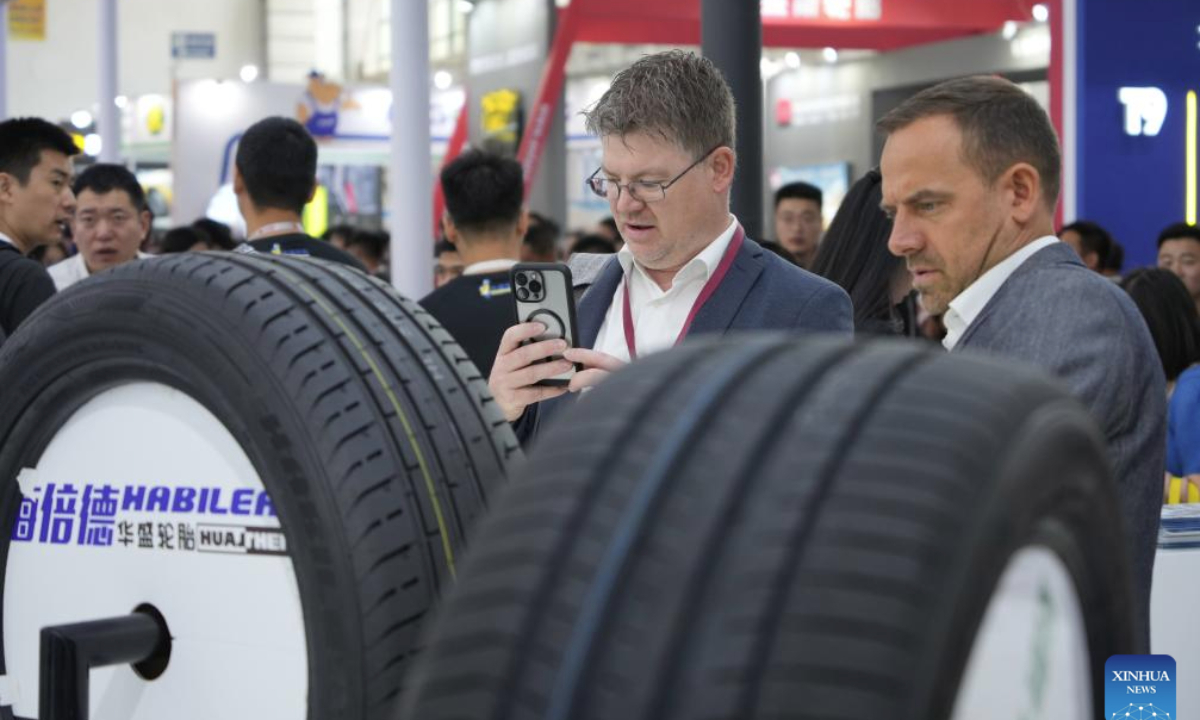
Foreign visitors take photos of rubber tyres at the 15th China (Guangrao) International Rubber Tire & Auto Accessory Exhibition in Dongying City, east China's Shandong Province, May 15, 2025. Featuring over 800 exhibitors, the event has lured professional buyers from more than 70 countries and regions worldwide. (Xinhua/Xu Suhui)
The European Commission (EC) launched an anti-subsidy investigation into tyres for cars and lighter trucks and buses from China on Thursday, citing so-called evidence that Chinese producers were benefitting from government subsidies. A Chinese trade expert viewed the move as a protectionist tactic that warps fair competition, risks Europe's own industries while harming consumers and operators.
A legal notice on the EU official website showed that the investigation was initiated at the request of the Coalition Against Unfair Tyre Imports, comprising EU producers, and claimed that the volume and prices of the imported product under investigation have had caused so-called a negative impact on the Union industry.
The investigation targets new rubber pneumatic tyres designed for passenger cars, including station wagons and racing cars, as well as buses and trucks with a load capacity rating of 121 or less. The Commission is bound to conclude its investigation no later than 13 months, and can impose provisional measures within nine, according to the EC notice.
This is not the EU executive's first foray into scrutinizing Chinese tyres. In May this year, the EC initiated an anti-dumping investigation on the same product, which will be completed within July 2026, and this move has previously been criticized by the Chinese Ministry of Commerce (MOFCOM) as creating trade barriers and seen by industry experts as self-sabotaging for Europe's own sector.
The latest anti-subsidy measures against China are essentially protectionist at their core, rooted in the EU executive's long-held, skewed view of China's industry policies - which has long served as a pretext for rolling out these unilateral trade barriers, said Jian Junbo, director of the Center for China-Europe Relations at Fudan University's Institute of International Studies.
This move actually also covers up the fact that the EU's related industries have low competitiveness in terms of efficiency, cost, and innovation, and blaming their own problems on China is a mistaken attribution, Jian told the Global Times.
Jian further noted that these probes ignore how Chinese exports help keep tyre prices affordable in Europe, benefiting everyone from everyday drivers to fleet operators. If these restrictions go through, they'll jack up costs for European downstream industries and consumers' purchasing costs, ultimately harming their interests, Jian warned.
He also cautioned that such protectionism will create a hotbed lacking competitive pressure, stifling technological upgrades and efficiency improvement of European industries, further weakening their international competitiveness. Protectionist practices will not only disrupt global trade flows but also harm the atmosphere for bilateral economic cooperation, ultimately undermining political mutual trust, Jian added.
This year the European Commission, the EU executive, has opened 15 investigations and imposed final duties on 18 mostly Chinese products, from tinplate to wooden flooring, according to a Reuters report on October 24, which the Chinese expert said is evidence that the EU side may be abusing trade remedy tools.
According to data from MOFCOM, this year the EU has initiated 7 original investigations against China, accounting for nearly 40 percent of its total foreign investigations, involving about $3.5 billion in Chinese exports, and has made preliminary or final rulings on 28 cases. It has 95 trade remedy measures against China in effect, involving about $39.3 billion in Chinese exports.
In May 29, commenting on the EC's anti-dumping probe on Chinese tyres, MOFCOM spokesperson He Yongqian said that trade protectionist measures will only increase the burden on consumers, create trade barriers and disrupt the stability and smooth functioning of value and supply chains, ultimately harming both sides.
The spokesperson said that China has consistently advocated for the prudent and reasonable use of trade remedy measures, urging the EU to refrain from taking unilateral trade-restrictive actions and resolve mutual concerns through dialogue and consultation. China will closely monitor EU's next moves and will firmly safeguard the legitimate rights and interests of Chinese enterprises, He said.
China will maintain dialogue and communication with the EU, properly handle economic and trade differences, deepen mutually beneficial cooperation and promote the sound and forward-looking development of China-EU economic relations, injecting more certainty and positive momentum into China-EU ties and the global economy, the MOFCOM spokesperson said.