From November 17 to 18, 2025, Professor Zhao Minghao, Deputy Director of the Center for American Studies (CAS), Fudan University, participated in the Sixth U.S.–China Hong Kong Forum. The Forum was co-hosted by the China–United States Exchange Foundation (CUSEF) and the Chinese People’s Association for Friendship with Foreign Countries (CPAFFC) under the theme “Circles for Peace.”
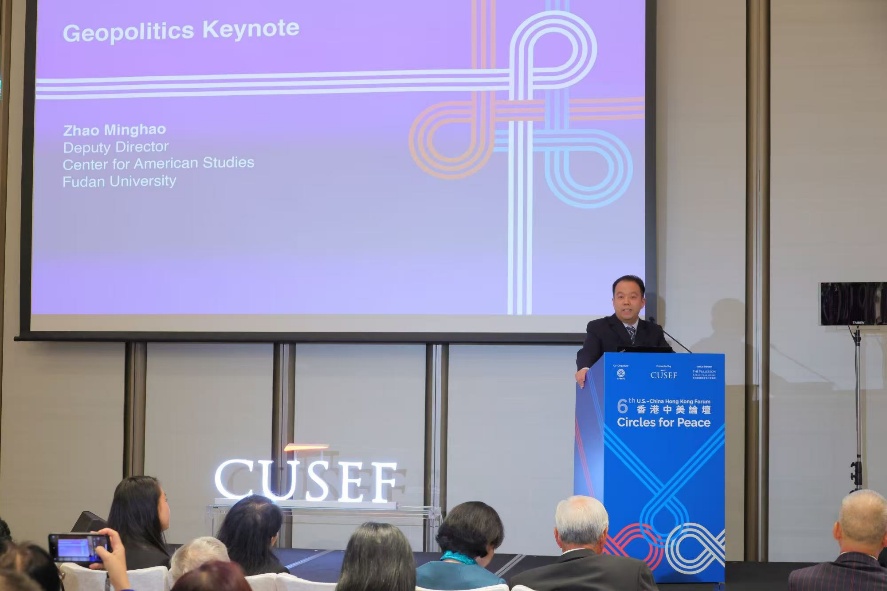
Opening remarks were delivered by Ambassador Xie Feng, Chinese Ambassador to the United States; Zhao Linghuan, Chairman of CUSEF; and Shen Xin, Vice President of CPAFFC. The ceremony was chaired by Zhou Jiancheng, President of CUSEF. John Lee, Chief Executive of the Hong Kong Special Administrative Region, attended the welcome dinner and delivered remarks.
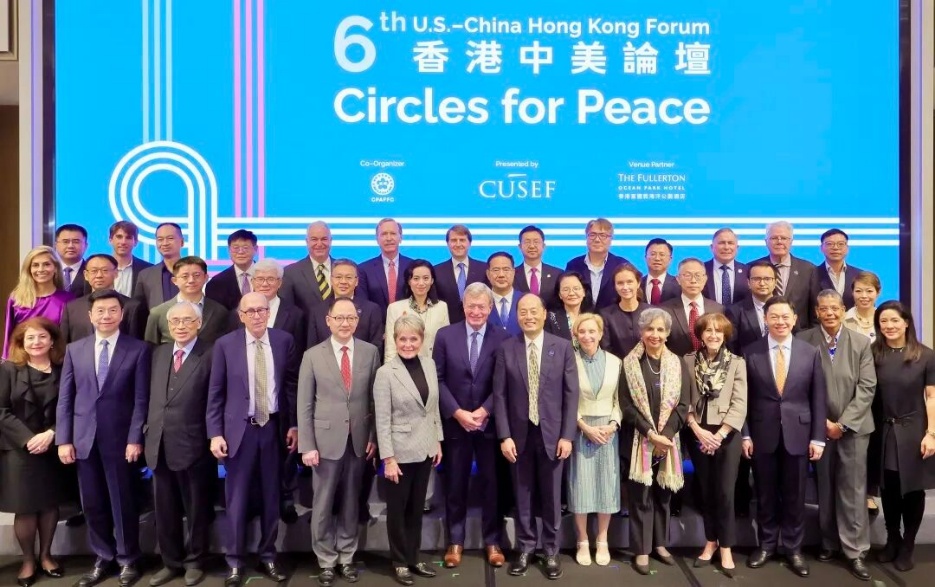
The Forum brought together over 350 participants from government, academia, business, and civil society. Distinguished attendees included Professor Wang Jisi, Founding Dean of the Institute of International and Strategic Studies at Peking University; Charlene Barshefsky, Chair of the National Committee on U.S.–China Relations and former U.S. Trade Representative; Max Baucus, former U.S. Ambassador to China; Nirupama Rao, former Indian Ambassador to both China and the United States; Muhammad Yunus, Nobel Peace Prize Laureate; Ng Eng Hen, former Singapore Minister for Defence; Neil Bush, Chairman of the George H. W. Bush Foundation for U.S.–China Relations; Kai-Fu Lee, CEO of 01.AI; and Stephen S. Roach, former Chairman of Morgan Stanley Asia and Chief Economist.
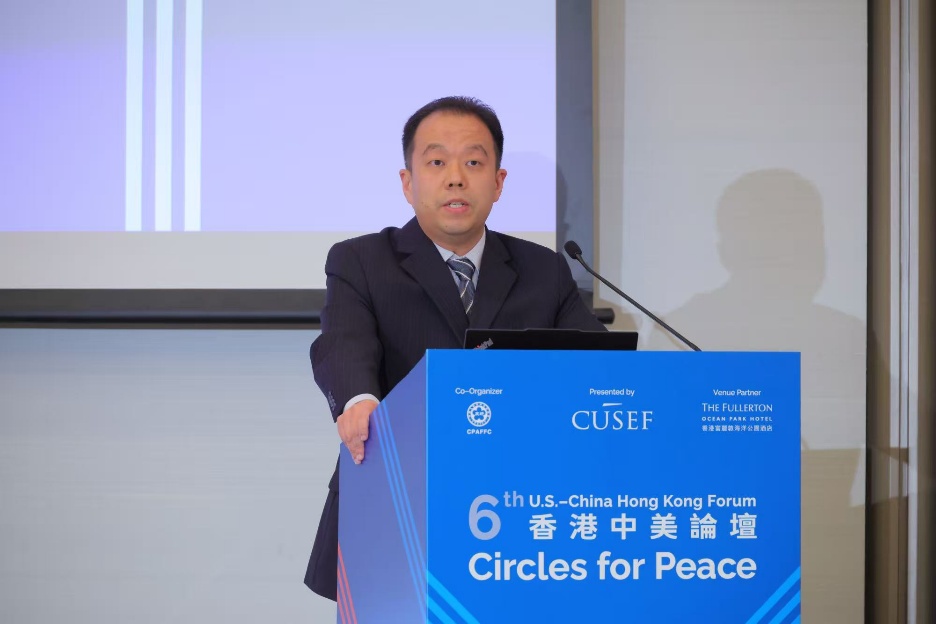
Professor Zhao delivered a keynote speech on geopolitical developments, emphasizing that the Busan summit between the Chinese and U.S. presidents had sent a positive signal for stabilizing bilateral relations. While cautioning against overinterpreting the “G2” concept raised by President Trump, he noted that the reference nonetheless reflected Washington’s renewed focus on major-power coordination. He stressed that “G2” should not be misunderstood as co-governance or a shift from competition to cooperation, but rather as a recognition of the need to recalibrate China–U.S. relations and enhance communication in a multipolar world.
Professor Zhao further noted that although the summit provided a foundation for future stabilization, deep-rooted tensions remain. Given longstanding structural differences, future disruptions are possible.
In discussing how to recalibrate the China–U.S. relationship, Professor Zhao emphasized the importance of expanding dialogue on how multipolarity is reshaping global dynamics, managing cross-regional security linkages with a renewed understanding of the Taiwan question, and addressing the growing entanglement of technology and national security by engaging experts, policymakers, and civil society in the search for workable frameworks of coexistence. He also expressed concern over the increasing securitization of people-to-people exchanges and called for the establishment of new rules to sustain these interactions, which are essential for maintaining long-term stability in bilateral relations.