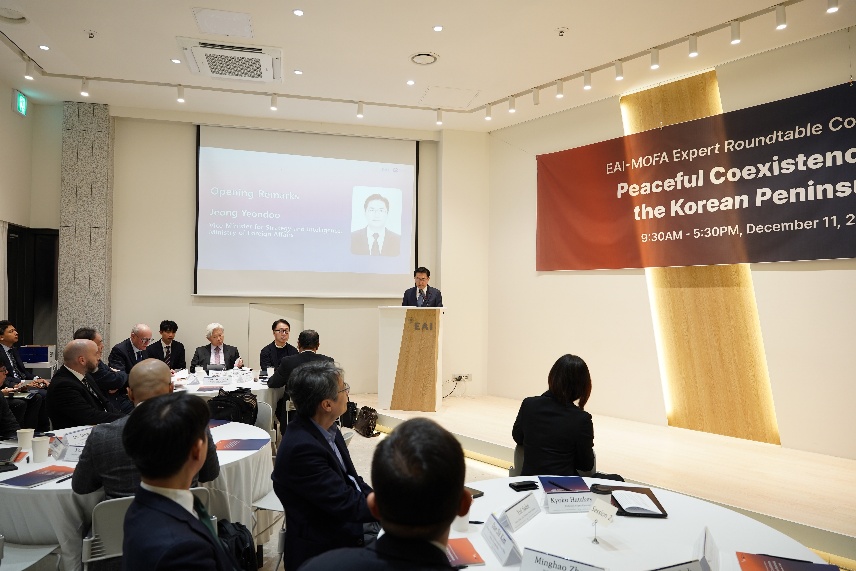
From December 10 to 12, 2025, Professor Zhao Minghao, Deputy Director of the Center for American Studies (CAS) at Fudan University, visited the Republic of Korea to participate in an international conference organized by the East Asia Institute (EAI). The event opened with remarks by Yeondoo Jeong, Vice Minister of Foreign Affairs of the Republic of Korea, and was chaired by Chaesung Chun, President of EAI and former President of the Korean Association of International Studies.
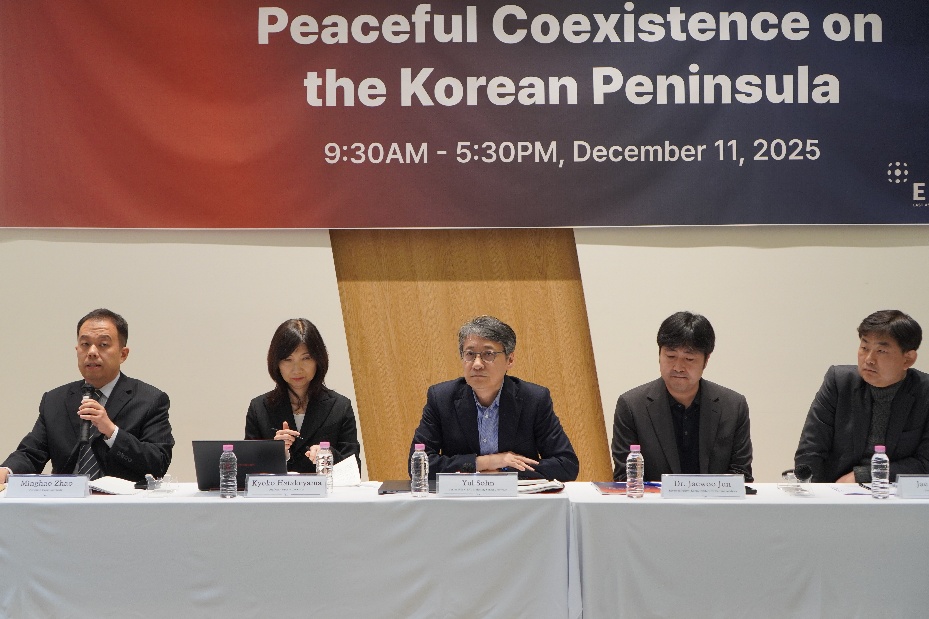
Professor Zhao delivered a presentation alongside leading scholars such as T. V. Paul of McGill University, Robert Ross of Boston University, Kyoko Hatakeyama of Niigata University, Ankit Panda of the Carnegie Endowment for International Peace, and Eric Ballbach. Discussants included experts from Seoul National University, Yonsei University, Ewha Womans University, the Sejong Institute, and the Korea Institute for Defense Analyses.
In his remarks, Professor Zhao emphasized that amid the prolonged Russia–Ukraine conflict and escalating tensions in the Middle East, preserving peace and stability in the Asia-Pacific remains critically important. He observed that the Korean Peninsula has seen growing instability in recent years, with heightened confrontation dynamics.
Reflecting on U.S.–China relations following the beginning of President Trump’s second term, Professor Zhao noted a period of intense rivalry followed by a gradual stabilization. From Geneva to Kuala Lumpur, economic and trade teams from both countries conducted multiple rounds of negotiations, ultimately reaching a framework agreement. Notably, in late October 2025, President Xi Jinping and President Donald Trump held a summit meeting in Busan, Republic of Korea. Professor Zhao argued that such high-level strategic communication contributes meaningfully to both regional and global stability. He further remarked that U.S.–China competition has entered a new phase. The Trump administration has shown increased willingness to engage in dialogue and explore areas of cooperation, while military-to-military exchanges between the two countries are gradually resuming.
Looking ahead to 2026, Professor Zhao highlighted two key developments likely to shape bilateral relations: the launch of China’s 15th Five-Year Plan and the upcoming U.S. midterm elections in November. These parallel timelines, he noted, will add complexity to the management of the relationship. Economic and trade talks between the two sides remain ongoing, with detailed negotiations continuing on specific provisions. Professor Zhao also cautioned against persistent hawkish sentiment in the United States, warning that such forces oppose any easing of tensions. He pointed to concerning trends in Trump administration policies on Taiwan and the South China Sea, as well as destabilizing external factors. In particular, he cited provocative remarks by Japanese politician Sanae Takaichi on the Taiwan issue, which risk exacerbating China–U.S. confrontation, along with the continuing uncertainty posed by the war in Ukraine. Reaffirming China’s commitment to developing stable relations with the Republic of Korea, Professor Zhao concluded by underscoring the importance of China–ROK ties for peace in Northeast Asia and the broader Asia-Pacific region. He then responded to questions from participants on China’s neighborhood diplomacy, military modernization, and technological competition with the United States.