(Source:Global Times,2026-04-08)
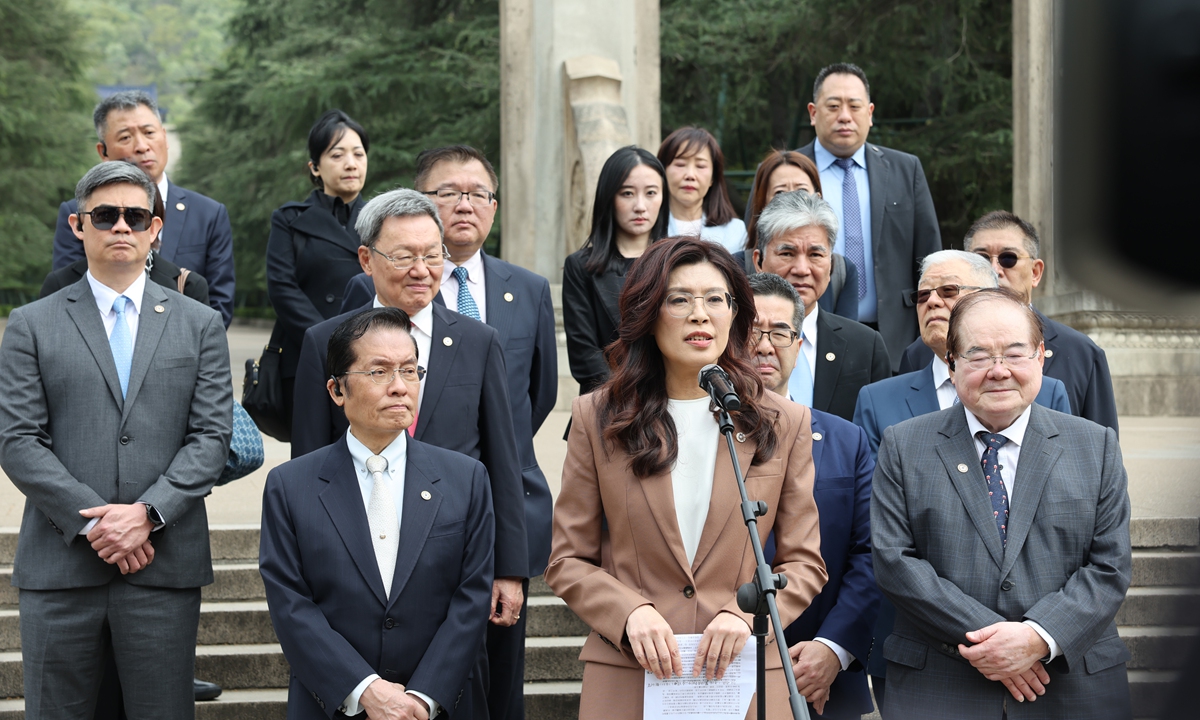
Cheng Li-wun, chairwoman of the Chinese Kuomintang (KMT), delivers a speech during a visit to the Sun Yat-sen Mausoleum in Nanjing, East China's Jiangsu Province, on April 8, 2026, as she leads a KMT delegation to pay homage. Photo: IC
Cheng Li-wun, chairwoman of the Chinese Kuomintang (KMT), led a KMT delegation on Wednesday morning to pay homage to the Sun Yat-sen Mausoleum in Nanjing, capital of East China's Jiangsu Province, according to the Xinhua News Agency.
The mausoleum is located in the eastern suburbs of Nanjing. Sun Yat-sen, a founding figure of the KMT and revered revolutionary leader who played a pivotal role in overthrowing imperial rule in China, died in 1925. His remains were buried here in 1929, Xinhua reported.
Today, after 21 years, I returned to the Sun Yat-sen Mausoleum, and my heart is filled with emotion, Cheng said in a speech that lasted about 18 minutes at the Sun Yat-sen Mausoleum, according to a video of the visit published by Taiwan media outlet United Daily News (UDN) on its YouTube channel on Wednesday.
Cheng choked up at one point during the speech. She said that 21 years ago, in early 2005, cross-Straits relations were extremely tense, and then chairperson of the KMT Lien Chan hoped to represent mainstream public opinion in Taiwan and break the ice across the Straits, Cheng noted, adding that she was deeply moved by this, and at Lien's invitation, formally joined the KMT and served as a spokesperson, according to the video.
Cheng's trip marks the first time in a decade that a KMT chairperson has led a delegation to the Chinese mainland. The visit is regarded as an important part of the exchanges and dialogue between the KMT and the Communist Party of China (CPC) under current circumstances. Paying homage to the mausoleum has long been an important part of KMT chairpersons' visits to the mainland, per Xinhua.
Xin Changxing, secretary of the CPC Jiangsu Provincial Committee, met with Cheng in Nanjing on Wednesday, during which he extended a warm welcome to Cheng and her delegation. Xin said that Cheng's visit to the mainland has received broad support from the people of Taiwan. It reflects the mainstream public opinion on the island in favor of peace, development, exchanges and cooperation, meets the needs of the development of cross-Straits relations, and accords with the shared aspirations of compatriots on both sides of the Taiwan Straits, according to a report from Jiangsu Broadcasting Corporation.
Cheng thanked Jiangsu for its warm and thoughtful arrangements for the visit, as well as for its long-standing care and support for Taiwan businesspeople and Taiwan-funded enterprises in the province. She added that they will continue to uphold the 1992 Consensus, oppose Taiwan independence, deepen exchanges and cooperation across various fields, work together to deliver more achievements, and better benefit compatriots on both sides of the Taiwan Straits, said the report.
The mainland extended Cheng a high-level reception, which shows that the mainland remains firmly in control of the broader direction of cross-Straits relations. So long as forces in Taiwan uphold the 1992 Consensus and are willing to engage, the mainland will extend appropriate courtesy and keep the door open to dialogue, exchanges and integrated development, despite obstruction from the DPP's anti-mainland stance, Xin Qiang, director of the Taiwan Studies Center at Fudan University, told the Global Times.
According to the itinerary released by the United Daily News, Cheng and the delegation are scheduled to travel to Shanghai for follow-up visits and activities. They are scheduled to travel to Beijing on April 9.
Both sides of the Taiwan Straits belong to one China. People on both sides are Chinese and part of one family. Affairs across the Straits are matters for people on both sides to resolve themselves. Our compatriots on both sides have the ability to properly handle their own issues, Zhu Fenglian, a spokesperson for the State Council Taiwan Affairs Office, said on Wednesday when asked to comment on Cheng's visit to the mainland.
We are willing, on the common political foundation of adhering to the 1992 Consensus and opposing Taiwan independence, to work with all political parties, organizations, and individuals in Taiwan island, including the KMT, to promote the peaceful development of cross-Straits relations, seek peace in the Taiwan Straits, bring well-being to our compatriots, and achieve national rejuvenation, Zhu said.
Taiwan media extensively covered Cheng's visit to the mainland on Wednesday. For example, regional media China Times published a full account of Cheng's speech at the Sun Yat-sen Mausoleum.
While media outlet SETN noted that when Cheng paid tribute at the Sun Yat-sen Mausoleum, she was greeted by mainland residents chanting slogans such as Welcome, reunification of the motherland, People on both sides of the Taiwan Straits are one family. Cheng responded with a smile and a wave, and paused to admire the bronze cauldron, exclaiming, Wow, this is amazing.
KMT spokesperson and legislator Niu Hsu-ting said in an interview on the BCC News Network program on Tuesday that the KMT believes risks across the Taiwan Straits can be managed and conflict reduced through dialogue, and sees this as a path to peace. He said this not only serves social stability, but also aligns with international expectations. If dialogue can help avert war, stabilize the situation, and manage risks, there is nothing wrong with any party choosing to pursue it. That, he said, is the broad and proper path forward.
Since Lai Ching-te took office, cross-Straits relations have remained tense. Cheng's visit responds to concerns among the Taiwan public and sends a signal in support of maintaining peace and stability in the Taiwan Straits. While it cannot resolve the underlying problems, the trip could still help reduce tensions and create room for further de-escalation, Wang Yingjin, director of the Center for Cross-Straits Relations Studies at the Renmin University of China, told the Global Times.
The current basis for stabilizing cross-Straits relations includes upholding the 1992 Consensus, maintaining peace and stability in the Taiwan Straits, opposing Taiwan independence, and restoring exchanges and cooperation across the Straits, including party-to-party platforms, economic forums, and other dialogue mechanisms. Against this backdrop, Cheng's visit is seen as a positive step toward easing tensions, according to Wang.