(Source:Global Times,2026-05-25)
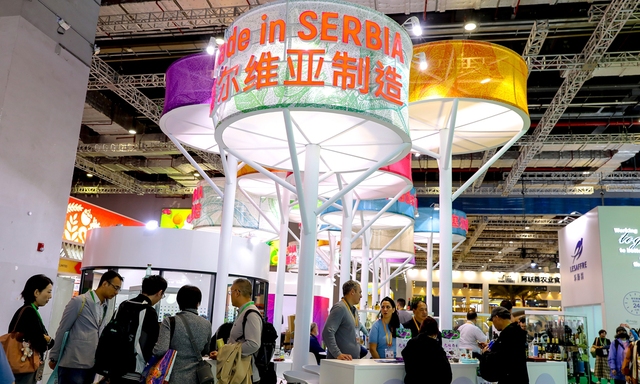
A booth showcasing Serbian products at the 8th China International Import Expo in Shanghai on November 8, 2025 Photo: VCG
The Chinese market is of exceptional importance to Serbian businesses because of its scale, sophistication and growing demand for quality, specialized and trusted products, Jelena Grubor Stefanovic, director of the representative office of the Serbian Chamber of Commerce and Industry in China, told the Global Times in an exclusive interview.
The remarks were made as President of Serbia Aleksandar Vucic is visiting China. Vucic arrived in Beijing on Sunday for a state visit to China from May 24 to 28, the Xinhua News Agency reported.
The state visit comes at a moment when Serbia-China relations are at their strongest level, said Stefanovic, noting that this visit is therefore expected to give additional political and economic momentum to an already strong partnership.
Ahead of his visit to China, Vucic met with Chinese Ambassador to Serbia Li Ming.
Vucic said that the trip would be the most important visit of his political career, and that he looked forward to using the visit as an opportunity to further cement the iron-clad friendship between the two countries, expand mutually beneficial cooperation, and deliver more tangible outcomes in building a China-Serbia community with a shared future for the new era for the benefit of both peoples, CCTV.com reported on Sunday.
The Serbian business representative said that there is genuine excitement on the Serbian side to see how this new phase of cooperation will take shape and what new opportunities it may open for both business communities.
As for the Serbian business community, the key expectation is that the visit will help expand and diversify bilateral cooperation, said Stefanovic. She said that Serbia and China have already passed through several phases of economic cooperation, naming multiple traditional sectors such as infrastructure and industrial investment, as well as the new and booming sectors such as technology, logistics, artificial intelligence, advanced manufacturing and green development.
Talking about the greatest potential for Serbian companies to expand their presence in China, Stefanovic said that great potential lies in agriculture and food exports, wine, premium food products, health and wellness products, niche industrial goods, digital services, advanced manufacturing and technology-based cooperation.

Jelena Grubor Stefanovic, director of the representative office of Serbian Chamber of Commerce and Industry in China Photo:Courtesy of Jelena Grubor Stefanovic
Jelena Grubor Stefanovic, director of the representative office of Serbian Chamber of Commerce and Industry in China Photo: Courtesy of Jelena Grubor Stefanovic
Vehicles are also a major strategic area. The global industry is now moving toward EVs, batteries, smart mobility, power electronics and embedded software... Cooperation with China, which today has one of the most advanced global automotive ecosystems, can help Serbia modernize this key industrial segment and move into the next phase of electric mobility, she said.
Bilateral economic and trade relations have continued to develop. According to statistics from the General Administration of Customs, bilateral trade reached $6.48 billion in 2025, up 13 percent year-on-year. Both imports and exports recorded positive growth.
In October, the Serbian section of a Chinese-built high-speed railway opened, a flagship project of the Belt and Road Initiative in Central and Eastern Europe and a new milestone in the ironclad friendship between the two countries, the Xinhua News Agency reported.
New cooperation is also taking shape. In May, a 1.3 billion euro ($1.5 billion) contract to build a high-speed road in Serbia was signed by the Serbian government and Chinese infrastructure giant Shandong Hi-Speed Group. The new expressway will connect the central and eastern regions of Serbia, and the collaboration is expected to further strengthen the strategic and economic partnership between China and Serbia.
China today remains one of the key stabilizing forces in global trade and international economic relations, particularly through its continued support for multilateralism, infrastructure connectivity and open markets, Stefanovic said.
This year marks the first year of China's 15th Five-Year Plan (2026-30). Stefanovic said that China's 15th Five-Year Plan comes at a time when the global economy faces fragmentation, unilateralism and pressure on supply chains. In that context, China's continued opening-up sends an important signal: that global development still depends on connectivity, trade, technology exchange, industrial cooperation and stable supply chains.
She also took particular note of Chinese platforms such as the China International Import Expo and China International Supply Chain Expo, which also represent important pillars of China's broader opening-up efforts and its commitment to deeper global economic connectivity.
For Serbian companies, such openness creates opportunities to present food, wine, agricultural products, technology, services and niche industrial products to one of the most important markets in the world, said the Serbian business representative.
This visit once again sends a clear signal that China-Serbia relations continue to deepen, Jian Junbo, director of the Center for China-Europe Relations at Fudan University's Institute of International Studies, told the Global Times on Monday.
China has strong capabilities in manufacturing, infrastructure construction, green energy, and the digital economy. Cooperation with China can help enhance Serbia's economic autonomy and promote industrial development, said Jian. At the same time, as an important country in Central and Eastern Europe, Serbia has a geographic advantage as a gateway to the European market and a certain industrial foundation.
In the future, the complementarity between the two sides in terms of industry and markets is expected to be further strengthened, and it can play a more positive role in promoting overall China-Europe economic and trade relations, the expert said.