(Source:Global Times,2026-07-10)
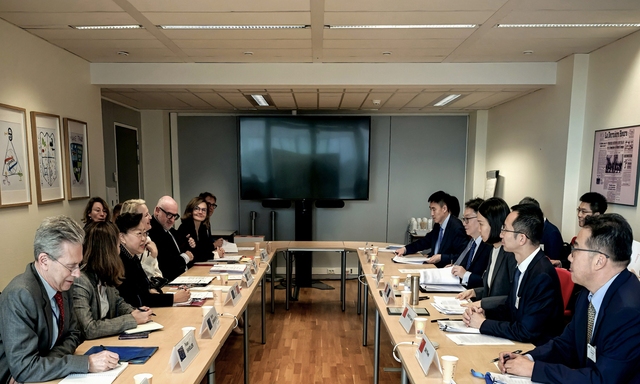
Chinese and EU officials conduct discussions at the headquarters of the EU on June 9, 2026. Photo: Ministry of Commerce website
China's Vice Minister of Commerce Ling Ji, also the deputy China international trade representative, met with Ditte Juul Jorgensen, director-general of the Directorate-General for Trade and Economic Security of the European Commission on Tuesday. The two sides held in-depth and comprehensive discussions regarding the preparations for the establishment of a China-EU trade and investment consultation mechanism, according to a statement on China's Ministry of Commerce (MOFCOM) website on Wednesday.
Both parties agreed to work toward tangible outcomes at the inaugural meeting of this mechanism, with a view to stabilizing bilateral economic and trade relations and promoting their sustainable development, the statement said.
Chinese experts said that the new consultation mechanism is poised to ease bilateral tensions, allay trade war fears, and lay the groundwork for future high-level dialogues. They urged the EU to heed rational voices and refrain from adopting protectionist measures that would harm healthy China-EU economic and trade relations while undermining its own economic and trade interests.
The progress shows that China-EU economic and trade relations are on a rational trajectory, as resolving trade frictions through dialogue would avoid harming both sides' economic and trade interests, Xin Hua, director of the Center for European Union Studies at Shanghai International Studies University, told the Global Times on Wednesday.
Since the start of 2026, the EU has been constantly updating its trade defense arsenal, introducing a series of restrictive measures targeting Chinese companies and products.
Most recently, the EU has been reportedly moving forward with a proposal that would require companies to reduce dependencies in their supply chains, with China bearing the brunt.
The EU's characterization of the China-EU trade 'imbalance' - and the measures it has adopted or proposed - are misguided. Such steps risk intensifying bilateral trade frictions and even damaging the broader relationship, Jian Junbo, director of the Center for China-Europe Relations at Fudan University's Institute of International Studies, told the Global Times on Wednesday.
He called on the EU to heed rational voices. Today, the more pragmatic approach for the EU is to properly manage differences through dialogue and consultation, promote the stable and healthy development of bilateral economic ties, facilitate deeper integration across industrial chains, and thereby achieve shared prosperity with China, Jian said.
Actions speak louder than words. A recent survey by the European Union Chamber of Commerce in China showed that European companies are doubling down on manufacturing in China despite the EU's de-risking push. Nearly one-third of respondents reported further onshoring in China, while 68 percent said that they were either maintaining or expanding operations, the Xinhua News Agency reported.
We are seeing EU companies actively adapting to China's dynamic business environment, as China is not only a market full of opportunities but has also become an indispensable source of innovation for their global operations, Denis Depoux, global managing director at German consulting firm Roland Berger, told the Global Times in a recent interview.
It is a fact that competition between some of China's and the EU's industries are on the rise, but industrial complementarity remains. From the market economy perspective, the EU should enhance its own competitiveness rather than attempting to hinder China-EU economic and trade cooperation through protectionist moves, Jian said.
This consultation mechanism is thus crucial for de-escalating tensions and ensuring stable ties. Ahead of Ling's trip to Brussels, the Global Times learned from a source who is familiar with the situation that Ling will discuss with European officials the relevant arrangements for establishing the China-EU trade and investment consultation mechanism.
This move demonstrates China's willingness in implementing the consensus of China-EU leaders and properly handling differences and frictions through dialogue and consultation, according to the insider, who declined to be identified.
China and the EU have maintained communication on bilateral economic and trade issues. On Thursday, Li Chenggang, China international trade representative with the MOFCOM and vice minister of commerce, met with European Commissioner for Trade and Economic Security Maros Sefcovic in Paris. The two sides had in-depth exchanges on World Trade Organization reform and China-EU economic and trade relations, according to the MOFCOM.
Xin noted that while the long-term trajectory of China-EU economic and trade relations points toward stability, continued dialogue is essential to bridge the perception gap and understand the structural complementarity underpinning bilateral ties.
Chinese Minister of Commerce Wang Wentao is also expected to visit the EU headquarters at the end of June for talks with Sefcovic, per a report by the South China Morning Post.