Illustration: Xia Qing/GT
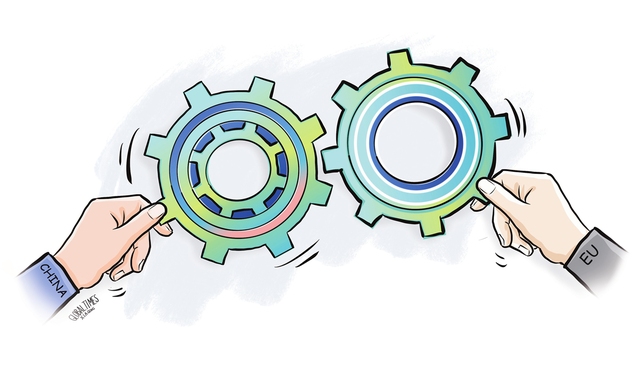
China is willing to maintain high-frequency communication with the EU, show mutual respect and meet each other halfway, explore practical and feasible solutions to each other's concerns in the economic and trade sectors, promote the upward balancing and forward development of China-EU trade, and maintain the stability and balance of the China-EU key trading partnership, China's Ministry of Commerce spokesperson He Yadong said at a regular press conference on Thursday.
A Chinese expert noted on Thursday that the remarks by the MOFCOM spokesperson have highlighted the Chinese side's proactive stance in promoting the China-EU trade relationship toward the direction of win-win cooperation, based on the deep integration and complementarity of industrial and supply chains, and pragmatic approach in addressing issues of mutual concern.
The MOFCOM's He made these remarks regarding the recent progress of the intensive consultations between China and the EU. He said that at the first meeting of the China-EU trade and investment consultation (TIC) mechanism, the two sides reached a consensus on the new positioning of a stable and balanced key trading partnership and reached preliminary agreement on holding the second meeting of the consultation mechanism in the fall of this year.
The spokesperson noted that over the past month, the Chinese side has actively implemented the consensus and outcomes of the first meeting, made full preparations for the second meeting, conducted intensive internal coordination, and maintained high-frequency, multi-level consultations with the EU.
On June 29, China's Minister of Commerce Wang Wentao and European Commissioner for Trade and Economic Security and Interinstitutional Relations and Transparency Maros Šefčovič co-chaired the first meeting of the TIC at EU headquarters, engaging in comprehensive, in-depth, and constructive discussions on major economic and trade issues, the MOFCOM said in a statement on July 2.
The two sides issued a joint statement after the meeting, agreeing to establish four workstreams under the TIC, namely trade and investment balancing, export controls, intellectual property rights, and World Trade Organization reform.
Jian Junbo, director of the Center for China-Europe Relations at Fudan University's Institute of International Studies, told the Global Times on Thursday that the progress disclosed by the MOFCOM spokesperson showed that the mechanism has initially produced positive impacts in guiding bilateral trade and investment issues toward stable and balanced development.
It shows that both sides, particularly China, are serious about tapping the function of the mechanism and addressing issues of mutual concern in a pragmatic manner, Jian said.
While the progress should be seen as an initial success of bilateral talks, it should be noted that the EU has taken unilateral measures recently that are widely seen as damaging Chinese interests, the expert noted, stressing that the EU must demonstrate more sincerity in addressing issues in a bilateral rather than uniliteral way.
Brussels has recently been intensifying its use of restrictive trade and regulatory tools across sectors ranging from clean technologies to digital infrastructure and foreign subsidies, with many of these measures seen as directly affecting Chinese firms and adding strain to China-EU economic relations.
In response to a question claiming that recently, some leaders from EU countries and institutions have expressed concerns that China's currency is undervalued, giving Chinese exporters an unfair advantage, Lin Weilong, an official of the MOFCOM, said on Tuesday at a press conference that China is not the root cause of Europe's economic and trade problems, but a partner that can help solve them. Protectionism leads nowhere; win-win cooperation is the right path.