WANG XIAOYING/CHINA DAILY
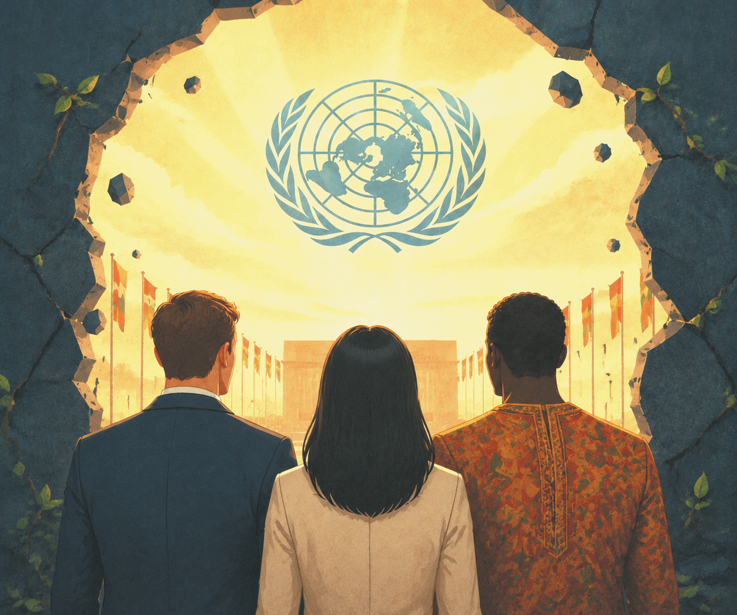
In the age of multilateralism, a new leadership will herald a more efficient, fair and powerful 'UN 2.0', steering it forward against multiple challenges to its authority, efficacy and representation
The world is watching closely as seven candidates move into the final stages of the race to become the 10th secretary-general of the United Nations.
In recent months, UN General Assembly President Annalena Baerbock has facilitated interactive dialogues and held a town hall debate among the candidates, member states and civil society representatives. Each candidate has articulated his/her vision for the UN's three pillars — peace and security, development, and human rights — and answered rigorous questions.
According to current rules, the secretary-general must be recommended by the Security Council and appointed by the General Assembly. The Security Council will conduct closed-door straw polls, and a candidate must secure at least nine votes without a veto from any of the five permanent members to move forward. Traditionally, from the perspective of regional rotation practices, the next secretary-general should come from Latin America. From the perspective of historical fairness, the UN has never had a female secretary-general in its 80-plus years of existence, and the calls for a woman to hold the position are growing louder. Four candidates meet both criteria, yet none has secured unanimous support from the five permanent members.
However, the question of how to lead outweighs who will be elected. UN General Assembly President Baerbock emphasized the need for strong, principled and effective leadership.
The multilateral system centered on the UN faces its toughest time since the end of the Cold War, including erosion of its authority, ineffectiveness of its resolutions and operations, geopolitical fragmentation, distrust among major powers, financial crises and unbalanced global governance. The UN requires a transformative leader; not a conventional chief administrative officer, but a new leader who is bold, connective and courageous.
This new leadership should manifest in nine key dimensions.
First, rebuilding trust and reducing division. Amid unilateralism, major-power competition and regional conflicts, the international community suffers from a severe trust deficit. The new secretary-general should act as a bridge-builder, fostering trust not only among member states but also between the UN and the global public. This role demands not just an administrative leader but a political leader capable of uniting a divided world.
Second, balancing the three pillars of peace. Peace and security, development and human rights are intrinsically linked and interdependent. While balancing these pillars is a global consensus, member states have divergent interests. The new secretary-general should possess systemic thinking and strategic coordination skills to find common ground and translate ideals into practical results.
Third, resolving financial crises. With some major powers chronically defaulting on dues, the UN faces a liquidity crisis, forcing budget and staffing cuts. The new secretary-general should drive fundamental financial reforms to restore member states' trust in the UN, demonstrating excellent management skills to both increase new revenue and cut expenses, while exploring new partnerships with the private sector for diverse and stable funding.
Fourth, upholding UN authority and effectiveness. In a rapidly changing global landscape, maintaining the UN's authority and effectiveness is the secretary-general's most fundamental and challenging mission. The future leader must reform the UN to reclaim its credibility, helping it better balance the interests of all member states and grow into an effective platform to lead global agendas and solve practical problems.
Fifth, accelerating the 2030 agenda and planning beyond. With only four years left until 2030, Sustainable Development Goals lag significantly behind schedule, with massive funding gaps amid multiple crises. The future secretary-general must act as both mobilizer and designer, sprinting toward current goals while strategically planning the post-2030 global development agenda, requiring diplomatic wisdom and strategic foresight.
Sixth, addressing underrepresentation of developing countries. This issue is not just about human resources but fundamentally concerns the UN's credibility and legitimacy. Many small and medium-sized countries are long underrepresented — a structural institutional flaw. The next secretary-general should go beyond symbolic appeals and traditional manager roles, driving substantive change with political resolve, diplomatic skill and execution capability.
Seventh, advancing systematic UN reforms. From Our Common Agenda to the Pact for the Future and the UN80 Initiative, the vision, goals and paths for reform are clear. The key lies in execution. The next secretary-general should steer reforms to strengthen the UN, including translating visions into actionable plans, enhancing work quality and efficiency, and leading the UN's active role in governance of emerging fields, such as artificial intelligence, to tackle future complex challenges.
Eighth, strengthening relations with civil society and the private sector. As transnational challenges grow more complex, global governance demands higher standards. The next secretary-general should connect governments, civil society and the private sector — a necessity for achieving the 2030 goals and rebuilding trust and effectiveness in multilateralism. The secretary-general must have political appeal and action-oriented leadership, innovatively building inclusive, effective partnership networks to inject new vitality into the UN.
Ninth, building relationships with the secretariat, member states and global citizens. The post of the UN secretary-general carries extremely heavy responsibilities and the new secretary-general must build a team that efficiently serves member states and global citizens as the Secretariat's chief executive officer. As a servant and coordinator of 193 member states, the secretary-general must carefully balance service and independence; they must advocate for the vulnerable. Building these relationships requires moral courage, political wisdom and excellent communication skills.
As a permanent member of the Security Council, China plays a crucial role in the election of the UN secretary-general. China has expressed its commitment to participating responsibly in the electoral process, supporting the UN in revitalizing its authority and energy to better serve as the core of global governance. China's criteria for the next secretary-general are clear and firm: adherence to the Charter, outstanding capability, fairness and accountability.
The world stands at a crossroads of multilateralism. A secretary-general with new leadership could help transform the UN into a more efficient, fair and powerful UN 2.0, helping the UN overcome its current difficulties, shortcomings and deficiencies.
The author is the director of the Center for the Study of the United Nations and International Organizations at Fudan University. The author contributed this article to China Watch, a think tank powered by China Daily.