Delegates attend a presentation at the seminar China-Visegrad 4 Relations: The Paths Forward, held on Friday (Aug 21). [Photo provided to chinadaily.com.cn]
The Visegrad Four countries can play a bigger role in promoting Europe's relationship with China by building on their growing economic links with the country and their unique position connecting Western Europe with Asia, experts from both China and Central Europe said.
Artur Bekmatov, adviser to the Prime Minister of Slovakia, said the four Central European countries — Slovakia, Hungary, Poland and the Czech Republic — possess advantages ranging from their geographical location to strong industrial traditions and skilled workforces that could enable them to exert a positive and pragmatic influence on China-Europe relations.
For him, the benefits of economic engagement go beyond trade and investment figures. Investment can create better jobs, give people more choices and improve their lives, while Slovak companies can also find opportunities in the Chinese market, making cooperation beneficial to both sides, he said.
The experts made the remarks at a seminar titled China-Visegrad 4 Relations: The Paths Forward, held on Aug 21, 2026. The event was co-organized by the Center for China-Europe Relations at Fudan University and Slovakia's Institute for Social Analyses.
The Visegrad Group, or V4, was first established in 1991 by Poland, Czechoslovakia and Hungary in the city of Visegrad, and took its current four-member form with Czechoslovakia peacefully separating into the Czech Republic and Slovakia in 1993. All four joined the European Union in 2004 and the Schengen Area in 2007. While their policies have diverged on a number of issues in recent years, the V4 has remained a platform for regional coordination for more than three decades.
A few decades ago, we started to understand that we can live better in case we are cooperating than in case we are fighting against each other, Bekmatov said. Now our role is to explain to our people that a similar principle applies to relations with China, and it is better to cooperate with China than to engage in confrontation.
Levente Horvath, head of the Center for Asian-Hungarian Relations at Mathias Corvinus Collegium and former Hungarian consul general in Shanghai, also stressed that Central European countries' engagement with China should be understood primarily through the lens of their own economic interests rather than ideological alignment.
He cited Hungary's Opening to the East policy as an example, saying that it was friendly to China but designed to serve Hungarian interests. The policy was based on the recognition that the structure of the world economy was changing and Hungary should not depend exclusively on Western economies, he said. The center of gravity of the world economy is moving eastward as China and other Asian countries emerge economically. Therefore, we need cooperation.
He was echoed by Li Zhengdong, an associate researcher at the Institute for Central and Eastern European Economic and Trade Cooperation at Ningbo University, who said that In Europe's public discourse, policies are politically acceptable when they are seen as serving Europe's own interests. Cooperation based on shared interests is therefore the best approach. Both sides can be open and pragmatic about what they want, and such cooperation is also more likely to win support at home.
China's economic presence in Hungary has grown significantly over the past decade, particularly as Chinese companies have invested in electric vehicles, batteries and other manufacturing industries. Horvath, however, noted that investment from other Asian economies, including South Korea, has also expanded rapidly in Hungary, arguing that debates surrounding Chinese investment are therefore sometimes influenced by political and ideological considerations in addition to economics.
China is one of the world's biggest, strongest and most important countries, so we still have to continue our cooperation with China, he said.
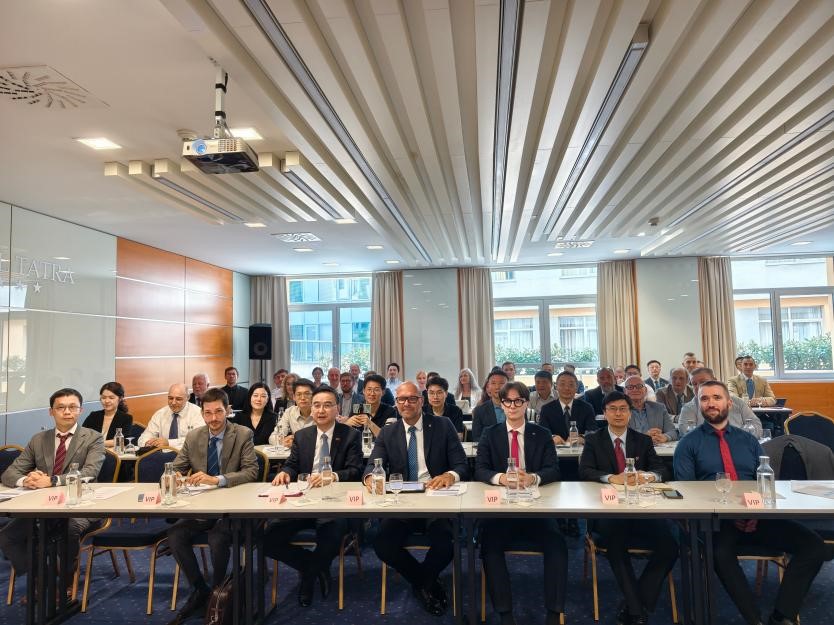
Delegates pose for a group photo at the seminar China-Visegrad 4 Relations: The Paths Forward, held on Friday (Aug 21). [Photo provided to chinadaily.com.cn]
Potential stabilizing force
For Horvath, geography and investment flows give the V4 an unusual position in Europe.
In our region, we have a lot of Western European investment, but we also have a lot of Chinese and other Asian investment, Horvath said. If the four countries can cooperate, they can be a bridge and connection between East and West.
Horvath also pointed to differences in historical experience between Central and Western Europe. Unlike several major Western European powers, the V4 countries did not build overseas colonial empires, which he believes has contributed to a different outlook toward China and other Asian countries.
He argued that this historical background could make it easier for Central European countries to approach cooperation with China on the basis of mutual respect, although changes of government mean policies toward China can sometimes fluctuate substantially in individual V4 countries.
Jian Junbo, professor and director of the Center for China-Europe Relations at Fudan University, said the V4 already occupies an important position in China's economic relations with Central and Eastern Europe, both in trade and investment.
More importantly, he said, the grouping gives its members a regional platform through which they can retain a degree of policy autonomy within the broader European debate.
Such room for independent policymaking could be particularly valuable when China-EU relations encounter difficulties, Jian said.
When China’s relations with the EU, particularly with some Western European countries, face major challenges, the V4 can, to a certain extent, play a role in stabilizing the overall China-Europe relationship, he said.
Bekmatov said cooperation should ultimately be judged by whether it produces tangible benefits for ordinary people, including jobs, economic opportunities and improved living standards.
That principle, he suggested, is also part of the reason the V4 itself has survived despite historical disputes and contemporary political differences among its members, which can be applied to international relationship if possible.
We understand that we can live better by cooperating than by acting against each other, he said.