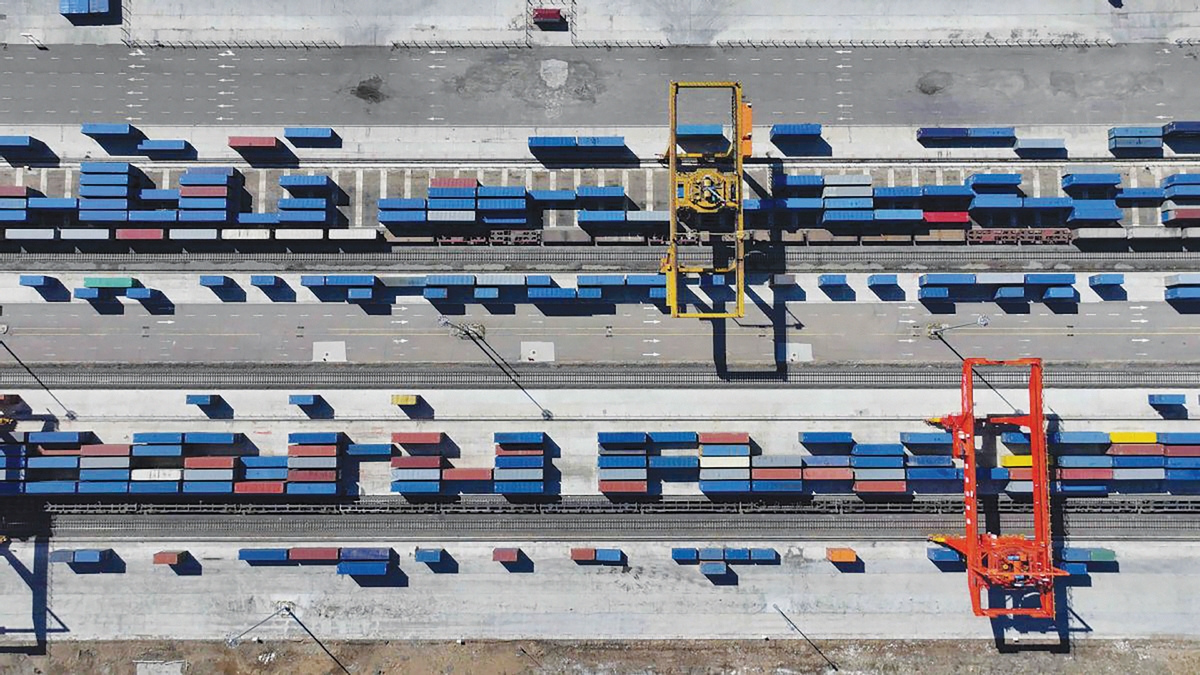
The Manzhouli land port in China's Inner Mongolia autonomous region recorded 678 China-Europe freight trains in the first quarter of this year, a 7.1-percent increase on traffic year-on-year. Fu Guoliang / For China Daily
United States President Donald Trump reignited his tariff rhetoric on social media on Oct 10, announcing his nation would impose a 100-percent tariff on all Chinese imports starting Nov 1 — or even earlier, depending on any further actions or changes taken by China.
The sudden escalation caught financial markets off guard, sending shock waves through Wall Street and across the Atlantic, and caused anxiety among investors concerned about the potential for the world's two largest economies to be involved in a trade dispute.
It took only 48 hours for Trump to appear to hint he may not follow through with his tariff threat, posting on his Truth Social account on Sunday: Don't worry about China, it will all be fine! … The USA wants to help China, not hurt it!!!
The abrupt reversal was the latest example of Washington's unpredictable and blunt policies, which tend to use tariffs as a one-size-fits-all tool in dealing with international relations, said experts.
Last month, Trump called on members of the NATO military alliance and the European Union to hit China and India with tariffs of up to 100 percent. But in Brussels, policymakers refrained and showed Europe has no intention of mirroring America's tariff escalation against China.
Analysts note that Washington's tariff threats and political volatility are prompting Europe to rethink its reliance on the US, because aligning too closely with US protectionism could harm Europe's own economic interests and limit its strategic autonomy.
Europe's cautious response reflects a growing sense of economic realism. Many European industries, particularly Germany's, are deeply integrated into global value chains where China is a crucial partner, said Michael Schumann, chairman of the board of directors of the German Federal Association for Economic Development and Foreign Trade. German businesses have long been clear: they oppose protectionism, whether foreign or domestic. For Europe, automatically aligning with Washington's tariff demands would undermine its own interests. Prudence and dialogue, not escalation, sustain prosperity.
Strategic autonomy is no longer an abstract concept; it is becoming a practical policy. This does not mean outright distancing from the US, but rather acting in accordance with Europe's own interests. Europe's refusal to simply follow US trade directives carries short-term risks but also yields dividends, such as credibility, balance, and policy independence.
He added that Europe's restraint shows it is increasingly seeking to define its policies based on its own industrial and trade logic, rather than political alignment.
In addition, unlike the US administration, the EU separates tariffs and sanctions, and it needs coordination within its 27 member states before introducing tariffs to address specific cases of market disturbances, most notably what it deems to be unfair.
The latest example is the plan to protect the EU's steel industry from the impacts of global overcapacity by reducing the quota for tariff-free imports of steel, and doubling the level of out-of-quota duty to 50 percent.
Maros Sefcovic, European commissioner for trade, justified the measures proposed last week, saying: EU trade is about fair, rules-based competition,
and this measure will help our steel industry compete fairly amid increasing global overcapacity.
I look forward to opening consultations and negotiations with the EU's key trading partners in this sector through the WTO rules-based process.
Moreover, the measures were still subject to discussion within EU countries and the European Parliament, and the tariffs would take effect no sooner than next June, when the existing safeguards are due to expire.
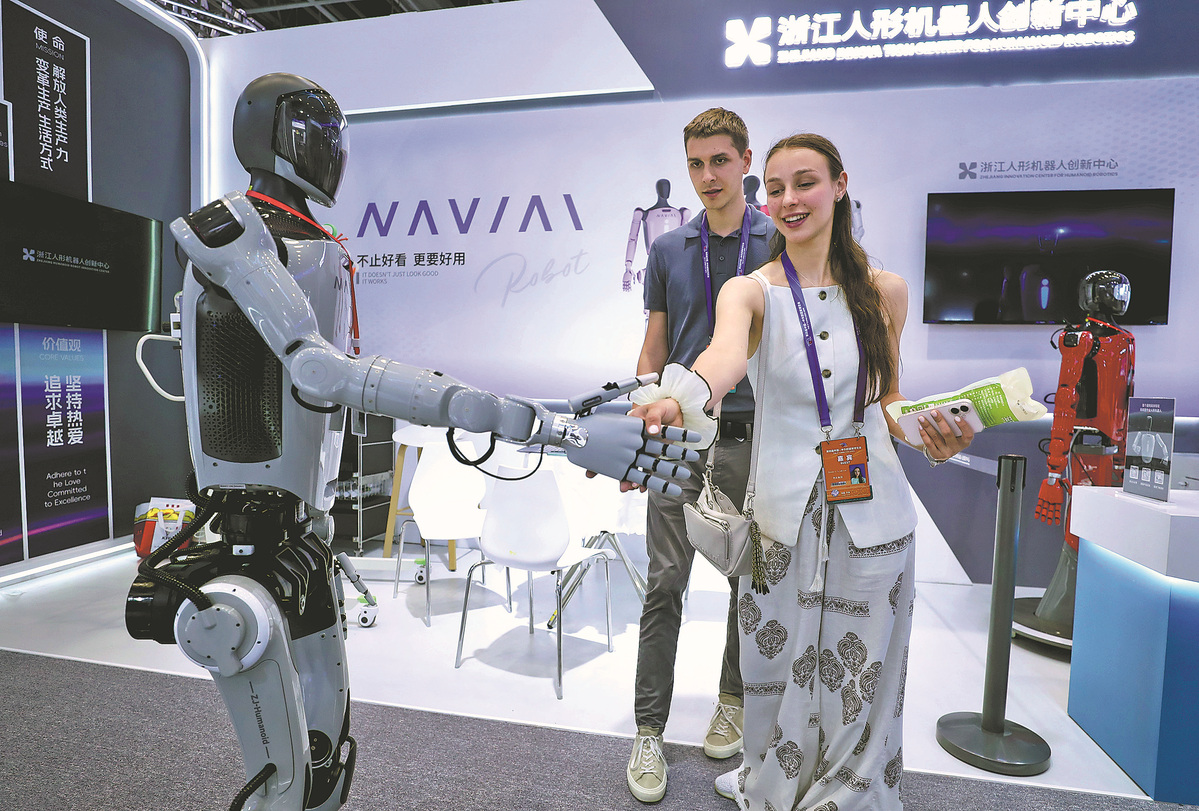
A guest shakes hands with a humanoid robot at the fourth China-Central and Eastern European Countries Expo in Ningbo, East China's Zhejiang province in May. The latest edition of the expo was not only a showcase for trade, technology, and cultural exchange, but also a microcosm of China-CEEC efforts to deepen mutual trust. ZHANG WEI / CHINA DAILY
Jian Junbo, director of the Center for China-Europe Relations at Fudan University in Shanghai, said the EU's steel tariffs show the rise of protectionism in the bloc, but are not directly targeting China.
The EU's economy was already hit by Trump's global tariffs war earlier this year, and it would not want to open another front of tariff war with China, Jian said.
And he noted the attitude toward China among the bloc's 27 members varies.
Countries like Germany, which have strong trade with China, don't want to see China-EU relations worsen. And France, which is one of the five permanent members of the UN's Security Council, emphasizes political communication with China.
Southern and Eastern European economies, including Spain, Hungary, and Serbia, see China as a source of investment for infrastructure and renewable projects.
These varied priorities make it difficult for Brussels to adopt a single hard-line trade position — and they explain why the EU prefers 'de-risking', said Jian. Economic relations were so deeply interdependent that it is impossible for China and Europe to 'decouple'.
China is the EU's second-largest trading partner for trade in goods, after the United States.
Meanwhile, the EU is China's second-largest trading partner, after the ASEAN bloc.
Bilateral trade in goods between China and the EU reached 732 billion euros ($846.9 billion) in 2024. However, the EU had a trade deficit of 305.8 billion euros, according to the European Commission.
Cameron Johnson, a senior partner at Shanghai-based consultancy Tidalwave Solution, said European countries want to solve this trade issue, but unlike the US, Europe actually has a lot more to lose with China, such as the internal Chinese market, as well as Chinese investment into the European Union.
The reality is that a tariff solution is very painful, and it doesn't solve the problem, he said.
With more than 20 years of management experience across various industries in China, Johnson noted that chemicals, automotive, and pharmaceuticals are the three main sectors that European companies have strong involvement in within China, and Chinese enterprises produce a lot of intermediate inputs and goods for products for European companies.
According to a report by Rhodium Group, Chinese FDI in the EU and UK reached 10 billion euros in 2024, up 47 percent on the previous year, and Europe captured 53.2 percent of Chinese investment in high-income economies.
The growing amount of Chinese investment in Europe was partly because of funding being diverted from the US because of the ongoing tension between the world's two largest economies, and the trend continues in 2025 after Trump signed an executive order in February to restrict investment from China in US technology, critical infrastructure, and energy.
Johnson said while the US will want Europe to hold the line in trading with China, particularly in things like semiconductors, Europe will also be closely watching the ongoing China-US trade talks, and studying what the US and China give each other.
If the US gives up a few technology restrictions to China and gets something in return, Europe might want to do something similar and vice versa with China as well, he added.
Nevertheless, the EU faces powerful coercion from the US.
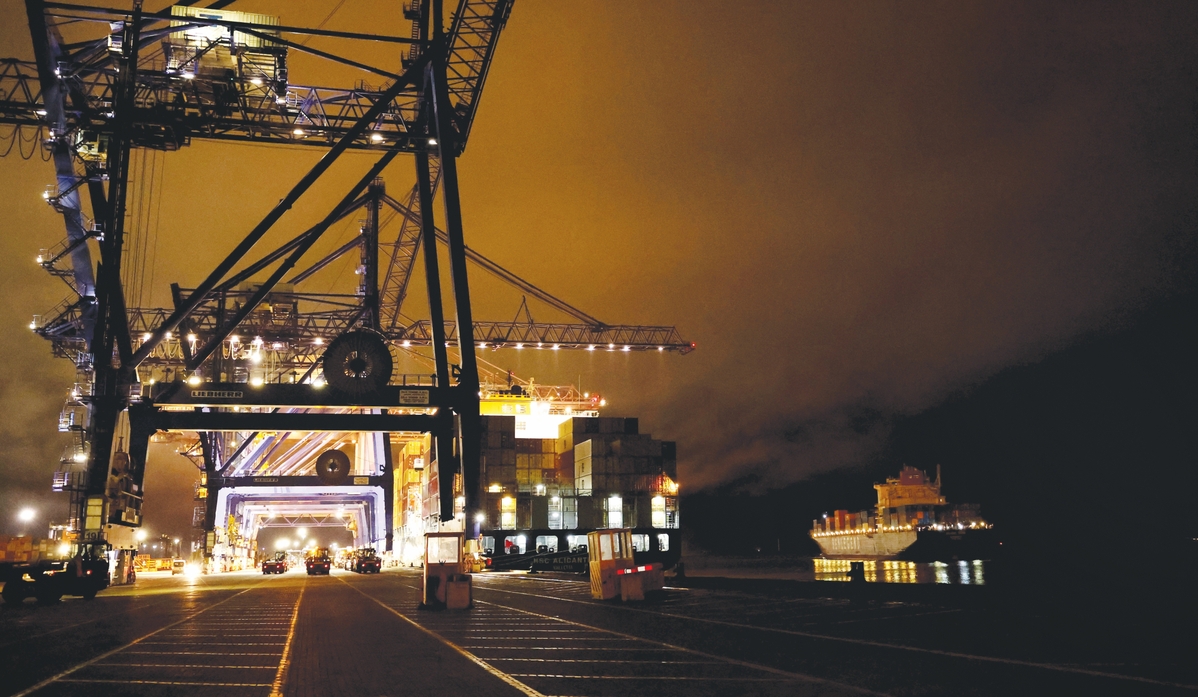
The first cargo ship (right) to ever travel on the China-Europe Arctic Express route arrives in the UK's largest container port, Felixstowe, on Oct 13. Loaded with about 4,000 containers from East China's Ningbo Zhoushan Port, the ship was set to unload at ports in the UK, Germany, Poland, and the Netherlands. Li Ying / Xinhua
Craig Burchell, chairman of Gerrha Global, a consultancy that focuses on EU-China collaboration, noted the prime example is the US refusing to allow ASML to sell China its products, which are essential to making semiconductors.
Burchell, an international law and policy expert based in Brussels, said: The EU is right to seek strategic autonomy. Because global stability requires three pillars, EU, China, and USA collaborating for a better world.
Since returning to office in January, Trump's renewed America First agenda has strained relations with the EU.
Ding Chun, vice-chair of the Chinese Association for European Studies and director of the Center for European Studies at Fudan University, said Trump's fickle position on the Russia-Ukraine conflict, his outrageous claim to want to annex Greenland, and his threats to throw Spain out of NATO, have cast doubt over traditional security alliances.
Trump's MAGA (Make America Great Again) movement has cracked a rift between the Transatlantic alliance, he added. From trade to security, there is also a need for the EU to de-risk from the US.
So, when it comes to China, Europe certainly doesn't want to be a 'pawn' of Washington. The EU doesn't want to be forced to choose sides between China and the US, but it doesn't want to be sidelined as well.
David Gosset, founder of the China-Europe-America Global Initiative, noted that China is quietly undergoing a transformative shift in its economic model — a move toward high-quality development that brings competition to the European market.
While there is no denying the mounting challenges, there is much to gain from collaboration, said the French sinologist, adding that both China and EU converge on issues including multilateralism and climate change that provide the foundation for a more cooperative future.
The EU and China should balance ideals with reality, embrace strategic autonomy, and focus on what they can achieve together. This will not only strengthen their relationship but also help bridge the divides between other economies and regions, promoting progress rather than regression, said Gosset.
Schumann echoed, saying: China remains essential for Europe in three dimensions: as a major market, a partner in innovation and sustainability, and a stabilizer in global supply chains. For Germany's export industries, China is both a key production site and a demand center, as well as a collaborator in technology and climate solutions. The relationship is one of interdependence, not dependence.
Europe benefits most when it manages this relationship with reciprocity, not rivalry.