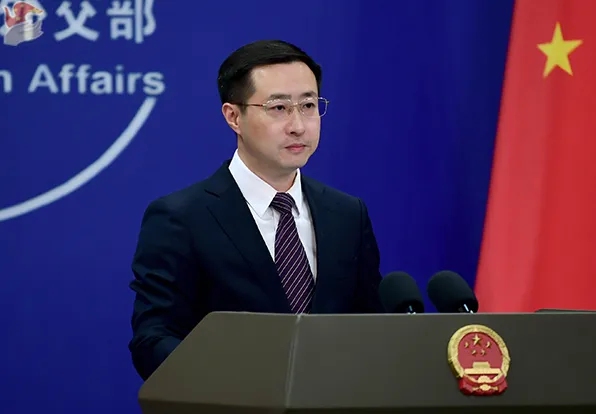
Chinese Foreign Ministry Spokesperson Lin Jian Photo: Foreign Ministry
In response to a Bloomberg report on Monday citing sources who said that the European Commission is exploring ways to force EU member states to phase out Huawei Technologies and ZTE from their telecom networks, Foreign Ministry spokesperson Lin Jian said at a regular press briefing on Tuesday that Chinese companies have all along done their business in Europe in accordance with the law, provided the European people with quality products and services, and made contributions to local socioeconomic development and employment.
The spokesperson said that to limit or ban companies' access to the market through administrative means without any legal grounds or factual basis severely violates market principles and the rules of fair competition.
Lin said that facts have demonstrated that in a handful of countries, the removal of Chinese telecom companies' quality and secure equipment not only handicaps their domestic technological development, but also results in heavy financial losses. Turning trade into security and political issues will hinder technological progress and economic growth and do no one's good.
We urge the EU to provide a fair, transparent and non-discriminatory business environment for Chinese companies and avoid hurting companies' confidence in their investment in Europe, he said.
Chinese experts criticized the reported move as a continuation of the EU's practice of invoking security to tighten scrutiny of and restrictions on certain Chinese products, condemning what they described as an increasingly pronounced tendency to turn economic and trade issues into security matters and to politicize them.
This [potential] direct exclusion of Chinese companies reflects an unreasonable and even distorted perception of the Chinese market and China-EU economic ties within some EU institutions, Jian Junbo, director of the Center for China-Europe Relations at Fudan University's Institute of International Studies, told the Global Times on Tuesday.
Such a move would not only harm Chinese firms but also backfire on Europe's own interests and disrupt normal bilateral economic cooperation, Jian said.
In relation to enterprises such as ZTE and Huawei, Jian noted that the EU has increasingly viewed normal commercial competition and technological cooperation through a so-called security lens, leading to an atmosphere of heightened alarm.
When security considerations override economic logic, the principles of free trade and market competition are inevitably undermined. If this trend of politicizing and turning economic ties into security issues continues to deepen, it could pose growing risks to the normal business development of Chinese products in the European market, Jian warned.
Zhang Jian, a vice-president of the China Institutes of Contemporary International Relations, told the Global Times on Tuesday that such actions will only hurt Europe itself. They undermine market rules, damage the EU's international image, harm China-EU relations and create deeper economic difficulties for Europe, he said. If Europe cannot step out of this self-defeating trap, its economic and social development will face even greater challenges—and Europe will end up less secure.
Although the European Commission has made the proposal, implementation lies with member state governments. Given market needs and cost considerations, some countries may not fully exclude Chinese products. The outcome remains to be seen, but the situation warrants vigilance, Jian said.