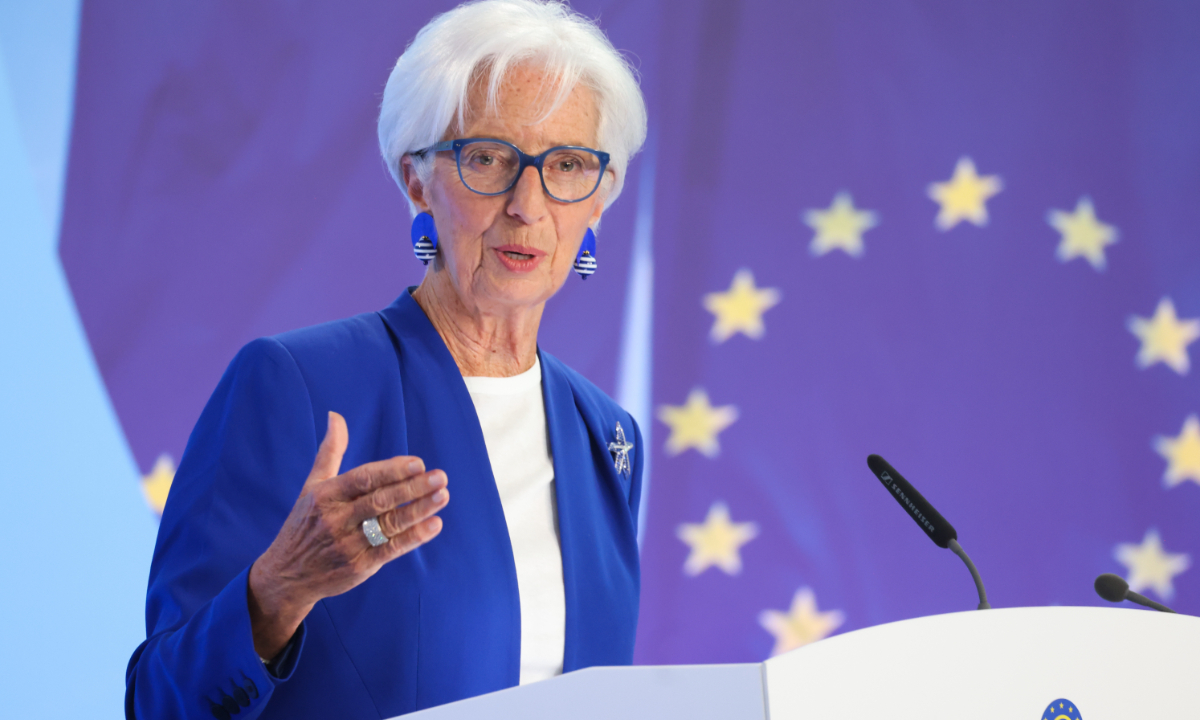
Christine Lagarde, president of the European Central Bank (ECB), speaks at a news conference in Frankfurt, Germany, on June 11, 2026. Photo: VCG
European Central Bank President Christine Lagarde on Monday local time urged global leaders to discuss the so-called undervaluation of the yuan as an aspect of the imbalances endangering the global economy, Reuters reported. Chinese analysts said that such narratives reflect a tendency to attribute global trade imbalances to China while overlooking Europe's own competitiveness challenges.
Assertions that the yuan is undervalued serve as a new protectionist pretext for hyping so-called trade imbalances with China, a move that risks undermining bilateral economic and trade ties, an expert said.
Lagarde cited IMF research and claimed that the yuan was undervalued by 15 to 16 percent after adjusting its nominal exchange rate for inflation differentials across economies, the Reuters report said.
She was responding to questions on comments by German Chancellor Friedrich Merz, who called for international talks about exchange rates as part of the EU's resolve to address its so-called deepening trade deficit with China, according to Bloomberg.
In recent months, Western politicians and institutions have continued to hype the yuan's exchange rate. A report released in February by France's Haut-Commissariat à la Stratégie et au Plan claimed that the yuan was undervalued by roughly 20 to 25 percent and argued that this had contributed to China's cost advantages.
Renewed Western rhetoric over the yuan's exchange rate, exemplified by Lagarde's latest remarks, reflects an attempt to revive claims of China's trade imbalance by using the currency issue as a pretext, thereby diverting attention from underlying weaknesses in Europe's own industrial competitiveness, said Jian Junbo, director of the Center for China-Europe Relations at Fudan University's Institute of International Studies.
Jian stressed that exchange rates are shaped by market-based mechanisms and are not policy tools that can be manipulated at will. Attempts by some European politicians to link the yuan's exchange rate to China's export competitiveness are ultimately self-defeating.
The People's Bank of China (PBC), the central bank, has previously noted in a report that short-term fluctuations of the yuan's exchange rate are driven by market forces, while its long-term trajectory is determined by economic fundamentals. The strong fundamentals of the Chinese economy provide a solid foundation for the yuan's stability, the PBC said.
In addition, PBC Governor Pan Gongsheng stressed at the China Development Forum 2026 that China has neither the need nor the intention to gain trade advantages through currency depreciation, according to the Xinhua News Agency.
Pan reiterated that the PBC's position has remained clear and consistent: allowing the market to play a decisive role in exchange-rate formation, maintaining exchange-rate flexibility, strengthening expectation management, and keeping the yuan basically stable at a reasonable and equilibrium level.
The problems Europe faces today stem largely from insufficient investment, slow industrial upgrading and other structural issues at home, not from China's exchange-rate policy, Jian said.
The EU's attempts to blame China for its own economic difficulties are signs of EU officials' failure to take responsibility, Jian said. Such an approach neither strengthens Europe's competitiveness nor contributes to healthy China-EU economic ties. Ultimately, it is a counterproductive choice that serves neither side's interests, he added.
Analysts said that the EU's focus on goods trade imbalances overlooks the broader structure of China-EU economic ties. While China runs a goods trade surplus with the EU, the bloc maintains a surplus in services trade.
China's services trade deficit with the EU reached $48.3 billion in 2025, official data showed. The EU was the largest source of China's services trade deficit, accounting for 41.6 percent of China's total services trade deficit with the rest of the world. In the area of intellectual property royalties alone, China paid the EU more than $10 billion.
The narrative over the yuan's exchange rate has come amid recent moves by the EU to intensify scrutiny of China's trade and industrial policies, which have been repeatedly rejected by Chinese officials.
Recent EU discussions further reinforced this trend. EU leaders meeting in Brussels agreed on Friday that the EU executive should enter dialogue with the bloc's main trading partners on global macroeconomic imbalances and review whether new trade measures were needed, according to the report, which said the focus was on China.
In response to the EU's plans to introduce new trade defense tools, the China Chamber of Commerce to the EU (CCCEU) noted on Monday that We hope that both sides will address trade frictions through dialogue and consultation. Unilateral trade measures risk provoking retaliatory actions and creating a cycle of escalating tensions that serves neither side's interests.
The CCCEU said via its official WeChat account that at a time of growing global uncertainty, China and the EU should work together to preserve an open, predictable, and rules-based trading environment.
Regarding China-EU economic and trade relations, Chinese Foreign Ministry spokesperson Guo Jiakun said early this year that We never seek a trade surplus; on top of being the world's factory, we hope to be the world's market too. We hope that the EU can have a long-term perspective and open attitude, and work with China in the same direction to promote the sustained and sound development of China-EU economic and trade ties.
The Chinese government always encourages and supports willing and capable Chinese companies to invest and do business in Europe based on market principles, he said.