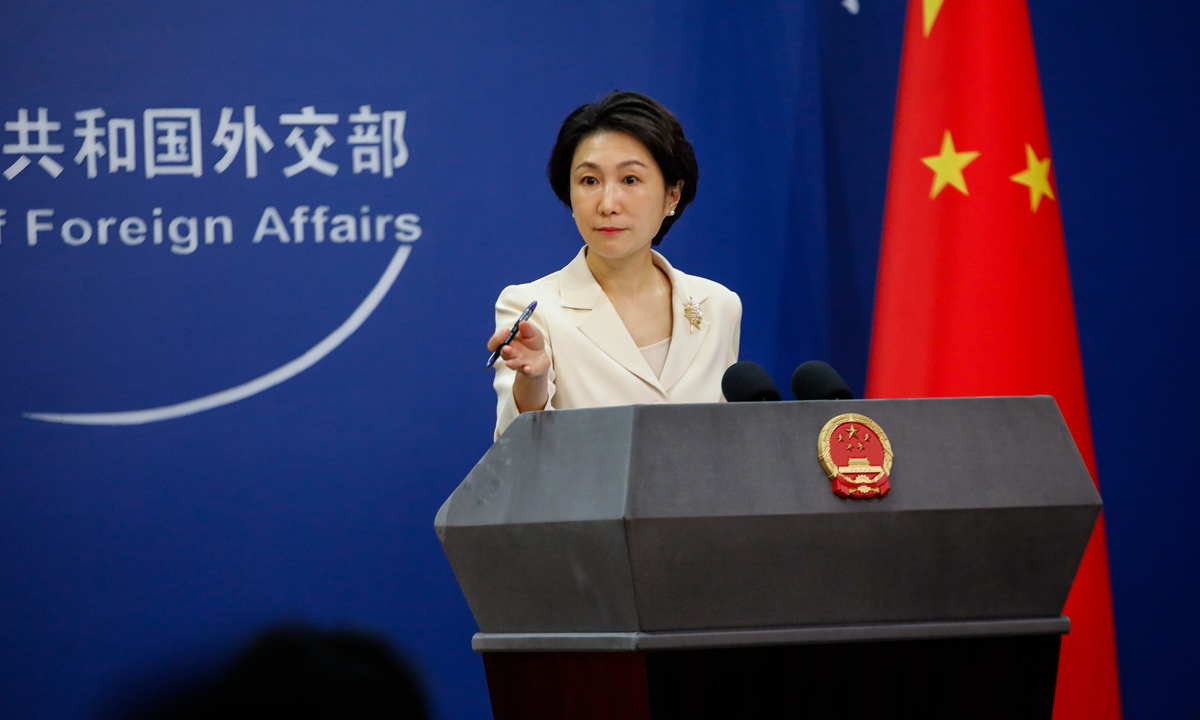
Chinese foreign ministry spokesperson Mao Ning
China is closely following the latest developments in the Middle East. Reigniting the conflict does not serve any party's interests. Military means cannot solve the fundamental issue, Chinese Foreign Ministry spokesperson Mao Ning said on Wednesday in response to a question about China's comments on the renewed fighting between the US and Iran.
We call on the US and Iran to follow through on their memorandum of understanding, resolve disputes through dialogue and negotiation, and avoid resorting to force, Mao said at a regular press conference.
US President Donald Trump said Wednesday that he considers the tentative ceasefire with Iran to be over, telling reporters alongside NATO Secretary-General Mark Rutte at the alliance's annual summit in Ankara, Turkey, that the agreement had become a waste of time, Fox News reported.
The interim ceasefire agreement signed between Washington and Tehran under the mediation of Pakistan was intended to provide a 60-day window for negotiations on a permanent agreement, but indirect talks in Qatar ended with no sign of headway and the US military unleashed a new wave of strikes against Iran on Tuesday, Reuters reported.
The US military completed a new round of strikes on Iran, hitting over 80 targets, according to a statement late Tuesday from US Central Command. The US also reimposed sanctions on Iranian oil sales in retaliation for attacks on commercial ships near the Strait of Hormuz, CNN reported.
In response, Iran's Islamic Revolution Guard Corps attacked 85 US military sites in Bahrain, Kuwait, in a new round of escalation of regional tensions. Iran's top joint military command said that its armed forces will give a crushing response to US attacks and will not allow US interference in the management of the Strait of Hormuz, according to the Xinhua News Agency.
Sun Degang, director of the Center for Middle Eastern Studies at Fudan University in Shanghai, told the Global Times on Wednesday that tensions between the US and Iran appear to have escalated once more, as the two sides may have fallen back into a pattern of reciprocal confrontations that have lingered between them for a long time.
It is possible that one major driver behind this latest wave of bilateral friction stems from their protracted disputes over the Strait of Hormuz, Sun said, noting that Iran tends to hold the view that it should take the lead in deciding security and navigation rules for the waterway, whereas the US seemingly hopes to preserve its military presence and regional influence across the Persian Gulf. There may exist a fairly prominent divergence in their respective strategic aspirations, the expert said.